Solution
Introduce
$$\boldsymbol{\beta}=\frac{\mathbf v}{c},\qquad \gamma=\frac{1}{\sqrt{1-\beta^2}}.$$
The components of the electric and magnetic fields parallel and perpendicular to $\boldsymbol{\beta}$ $\parallel$ $\perp$
The field transformation formulas are
$$\mathbf E'=\mathbf E_{\parallel}+\gamma\left(\mathbf E_{\perp}-[\boldsymbol{\beta}\times\mathbf B]\right),$$
$$\mathbf B'=\mathbf B_{\parallel}+\gamma\left(\mathbf B_{\perp}+[\boldsymbol{\beta}\times\mathbf E]\right).$$
a) Verification of the inverse transformation
After the first transformation with velocity $c\boldsymbol{\beta}$
$$\mathbf E'_{\parallel}=\mathbf E_{\parallel},\qquad \mathbf B'_{\parallel}=\mathbf B_{\parallel}.$$
The transverse components are
$$\mathbf E'_{\perp}=\gamma\left(\mathbf E_{\perp}-[\boldsymbol{\beta}\times\mathbf B]\right),$$
$$\mathbf B'_{\perp}=\gamma\left(\mathbf B_{\perp}+[\boldsymbol{\beta}\times\mathbf E]\right).$$
Now perform the inverse transformation by replacing $\boldsymbol{\beta}$ $-\boldsymbol{\beta}$
For the transverse electric field,
$$\mathbf E''_{\perp}=\gamma\left(\mathbf E'_{\perp}+[\boldsymbol{\beta}\times\mathbf B']\right).$$
Since the parallel component of $\mathbf B'$
$$[\boldsymbol{\beta}\times\mathbf B']=\gamma\left([\boldsymbol{\beta}\times\mathbf B_{\perp}]+[\boldsymbol{\beta}\times[\boldsymbol{\beta}\times\mathbf E]]\right).$$
Therefore,
$$\mathbf E''_{\perp}=\gamma^2\left(\mathbf E_{\perp}+[\boldsymbol{\beta}\times[\boldsymbol{\beta}\times\mathbf E]]\right).$$
Using
$$[\mathbf a\times[\mathbf a\times\mathbf b]]=\mathbf a(\mathbf a\cdot\mathbf b)-a^2\mathbf b,$$
and noting that only the transverse part of $\mathbf E$
$$[\boldsymbol{\beta}\times[\boldsymbol{\beta}\times\mathbf E]]=-\beta^2\mathbf E_{\perp}.$$
Hence,
$$\mathbf E''_{\perp}=\gamma^2(1-\beta^2)\mathbf E_{\perp}.$$
Since
$$\gamma^2(1-\beta^2)=1,$$
we find
$$\mathbf E''_{\perp}=\mathbf E_{\perp}.$$
The parallel component is unchanged as well:
$$\mathbf E''_{\parallel}=\mathbf E_{\parallel}.$$
Thus,
$$\boxed{\mathbf E''=\mathbf E}.$$
The same calculation for the magnetic field gives
$$\boxed{\mathbf B''=\mathbf B}.$$
Therefore, two successive transformations with velocities $c\boldsymbol{\beta}$ $-c\boldsymbol{\beta}$
b) Applications of the transformation formulas
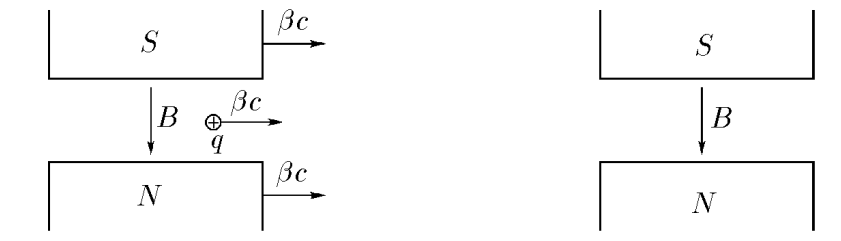
In the rest frame of the capacitor,
$$\mathbf B=0.$$
The capacitor moves parallel to its plates, whereas the electric field is perpendicular to them. Hence,
$$\mathbf E\perp\boldsymbol{\beta}.$$
Therefore,
$$\mathbf E'=\gamma\mathbf E,$$
and
$$\boxed{E'=\gamma E}.$$
Because of Lorentz contraction, the dimension of each plate along the direction of motion decreases by a factor $\gamma$
$$\boxed{\sigma'=\gamma\sigma}.$$
The magnetic field is
$$\mathbf B'=\gamma[\boldsymbol{\beta}\times\mathbf E].$$
Since $\mathbf E'=\gamma\mathbf E$
$$\boxed{\mathbf B'=[\boldsymbol{\beta}\times\mathbf E']}.$$
In magnitude,
$$\boxed{B'=\beta E'=\gamma\beta E}.$$
Thus,
$$\boxed{\sigma'=\gamma\sigma,\qquad E'=\gamma E,\qquad B'=\beta E'}.$$
The capacitor now moves at an angle $\alpha$
Since the electric field is perpendicular to the plates,
$$E_{\parallel}=E\sin\alpha,$$
$$E_{\perp}=E\cos\alpha.$$
The parallel component is unchanged:
$$\boxed{E'_{\parallel}=E\sin\alpha}.$$
The transverse component is multiplied by $\gamma$
$$\boxed{E'_{\perp}=\gamma E\cos\alpha}.$$
Therefore,
$$\boxed{E'=E\sqrt{\sin^2\alpha+\gamma^2\cos^2\alpha}}.$$
The magnetic field is
$$\mathbf B'=\gamma[\boldsymbol{\beta}\times\mathbf E],$$
so that
$$\boxed{B'=\gamma\beta E\cos\alpha}.$$
Since
$$E'_{\perp}=\gamma E\cos\alpha,$$
we have
$$\boxed{B'=\beta E'_{\perp}}.$$
Equivalently, in vector form,
$$\boxed{\mathbf B'=[\boldsymbol{\beta}\times\mathbf E']}.$$
If the transformed surface charge density is also required, the area of a plate transforms as
$$S'=S\sqrt{1-\beta^2\cos^2\alpha},$$
and therefore
$$\boxed{\sigma'=\frac{\sigma}{\sqrt{1-\beta^2\cos^2\alpha}}}.$$
Let $\rho$
The electric field of an infinite charged wire in Gaussian units is
$$E_r=\frac{2\rho}{r},$$
where $r$
There is no magnetic field in the rest frame:
$$\mathbf B=0.$$
Since the wire moves along its own direction, the electric field is perpendicular to $\boldsymbol{\beta}$
$$E'_r=\gamma E_r.$$
Therefore,
$$\boxed{E'_r=\frac{2\gamma\rho}{r}}.$$
Lorentz contraction also gives the transformed linear charge density
$$\boxed{\rho'=\gamma\rho}.$$
The magnetic field is
$$\mathbf B'=\gamma[\boldsymbol{\beta}\times\mathbf E].$$
Thus,
$$\boxed{B'=\beta E'_r=\frac{2\gamma\beta\rho}{r}}.$$
Hence,
$$\boxed{\rho'=\gamma\rho,\qquad E'_r=\frac{2\gamma\rho}{r},\qquad B'=\frac{2\gamma\beta\rho}{r}}.$$
In the original frame, the straight conductor is electrically neutral.
Let the volume charge densities of the ions and electrons be
$$\rho_i=\rho,\qquad \rho_e=-\rho.$$
The ions are at rest, while the conduction electrons move with speed $\beta c$
Consider a frame in which the conductor moves with speed
$$\beta_1c,$$
where
$$\beta_1=k\beta.$$
Define
$$\gamma_1=\frac{1}{\sqrt{1-\beta_1^2}}.$$
Ion charge density
The ions, initially at rest, move with speed $\beta_1c$
$$\boxed{\rho'_i=\gamma_1\rho}.$$
Electron charge density
First pass to the rest frame of the electrons.
Since their charge density in the original frame is $-\rho$
$$\rho_{e0}=-\frac{\rho}{\gamma},$$
where
$$\gamma=\frac{1}{\sqrt{1-\beta^2}}.$$
The relative velocity between the electron rest frame and the required frame is
$$\beta_2=\frac{\beta_1-\beta}{1-\beta_1\beta}.$$
The corresponding Lorentz factor satisfies
$$\gamma_2=\gamma\gamma_1(1-\beta\beta_1).$$
Hence,
$$\rho'_e=\gamma_2\rho_{e0}.$$
Therefore,
$$\boxed{\rho'_e=-\gamma_1(1-\beta\beta_1)\rho}.$$
The total charge density in the moving conductor is
$$\rho'_{\Sigma}=\rho'_i+\rho'_e.$$
Thus,
$$\boxed{\rho'_{\Sigma}=\gamma_1\beta\beta_1\rho}.$$
The conductor is therefore no longer electrically neutral in this frame.
Magnetic field
In the original frame,
$$\mathbf E=0.$$
The magnetic field of a straight conductor is perpendicular to the conductor and therefore perpendicular to $\boldsymbol{\beta}_1$
The transformation law gives
$$\mathbf B_1=\gamma_1\mathbf B.$$
Hence,
$$\boxed{B_1=\gamma_1B}.$$
Electric field
Since $\mathbf E=0$
$$\mathbf E_1=-\gamma_1[\boldsymbol{\beta}_1\times\mathbf B].$$
Using $\mathbf B_1=\gamma_1\mathbf B$
$$\boxed{\mathbf E_1=-[\boldsymbol{\beta}_1\times\mathbf B_1]}.$$
Therefore, in magnitude,
$$\boxed{E_1=\beta_1B_1}.$$
The final results are
$$\boxed{\rho'_i=\gamma_1\rho},$$
$$\boxed{\rho'_e=-\gamma_1(1-\beta\beta_1)\rho},$$
$$\boxed{\rho'_{\Sigma}=\gamma_1\beta\beta_1\rho},$$
$$\boxed{B_1=\gamma_1B},$$
$$\boxed{E_1=\beta_1B_1}.$$
Suppose that in the original frame there is only a magnetic field:
$$\mathbf E=0.$$
The transformed electric field is
$$\mathbf E'=-\gamma[\boldsymbol{\beta}\times\mathbf B].$$
The transformed magnetic field is
$$\mathbf B'=\mathbf B_{\parallel}+\gamma\mathbf B_{\perp}.$$
Since
$$[\boldsymbol{\beta}\times\mathbf B_{\parallel}]=0,$$
we have
$$[\boldsymbol{\beta}\times\mathbf B']=\gamma[\boldsymbol{\beta}\times\mathbf B].$$
Therefore,
$$\boxed{\mathbf E'=-[\boldsymbol{\beta}\times\mathbf B']}.$$
At low velocities,
$$\beta\ll1,$$
so that
$$\gamma\approx1,\qquad \mathbf B'\approx\mathbf B.$$
Hence,
$$\boxed{\mathbf E'\approx-[\boldsymbol{\beta}\times\mathbf B]}.$$
Thus, a field that is purely magnetic in one inertial frame generally contains an electric component in another frame.
Now suppose that in the original frame there is only an electric field:
$$\mathbf B=0.$$
Then
$$\mathbf E'=\mathbf E_{\parallel}+\gamma\mathbf E_{\perp},$$
and
$$\mathbf B'=\gamma[\boldsymbol{\beta}\times\mathbf E].$$
Since the parallel component of $\mathbf E'$
$$[\boldsymbol{\beta}\times\mathbf E']=\gamma[\boldsymbol{\beta}\times\mathbf E].$$
Therefore,
$$\boxed{\mathbf B'=[\boldsymbol{\beta}\times\mathbf E']}.$$
For
$$\beta\ll1,$$
we have
$$\gamma\approx1,\qquad \mathbf E'\approx\mathbf E.$$
Hence,
$$\boxed{\mathbf B'\approx[\boldsymbol{\beta}\times\mathbf E]}.$$
Thus, a field that is purely electric in one frame generally contains a magnetic component in another frame.
d) The limit $\beta\to1$
Consider the transverse components
$$\mathbf E'_{\perp}=\gamma\left(\mathbf E_{\perp}-[\boldsymbol{\beta}\times\mathbf B]\right),$$
$$\mathbf B'_{\perp}=\gamma\left(\mathbf B_{\perp}+[\boldsymbol{\beta}\times\mathbf E]\right).$$
Let
$$\mathbf n=\frac{\boldsymbol{\beta}}{\beta}$$
be a unit vector along the direction of motion.
As $\beta\to1$
$$\mathbf A=\mathbf E_{\perp}-[\mathbf n\times\mathbf B_{\perp}].$$
Then the leading transverse electric field is
$$\mathbf E'_{\perp}\sim\gamma\mathbf A.$$
Now,
$$[\mathbf n\times\mathbf A]=[\mathbf n\times\mathbf E_{\perp}]-[\mathbf n\times[\mathbf n\times\mathbf B_{\perp}]].$$
Since $\mathbf B_{\perp}\perp\mathbf n$
$$[\mathbf n\times[\mathbf n\times\mathbf B_{\perp}]]=-\mathbf B_{\perp}.$$
Therefore,
$$[\mathbf n\times\mathbf A]=\mathbf B_{\perp}+[\mathbf n\times\mathbf E_{\perp}].$$
Hence the leading transverse magnetic field is
$$\mathbf B'_{\perp}\sim\gamma[\mathbf n\times\mathbf A].$$
Thus,
$$\mathbf B'_{\perp}\sim[\mathbf n\times\mathbf E'_{\perp}].$$
A cross product is perpendicular to the vector from which it is constructed. Therefore, in the ultrarelativistic limit,
$$\boxed{\mathbf E'\perp\mathbf B'}.$$
The same conclusion follows from the Lorentz invariant
$$\boxed{\mathbf E'\cdot\mathbf B'=\mathbf E\cdot\mathbf B}.$$
The scalar product remains finite, whereas in the generic ultrarelativistic case
$$E'\sim\gamma,\qquad B'\sim\gamma.$$
Thus,
$$E'B'\sim\gamma^2\to\infty.$$
If $\theta'$
$$\cos\theta'=\frac{\mathbf E'\cdot\mathbf B'}{E'B'}.$$
Therefore,
$$\cos\theta'\to0,$$
and hence
$$\boxed{\theta'\to\frac{\pi}{2}}.$$
This statement refers to the non-degenerate case in which the leading transverse terms do not cancel.
Final results
The Lorentz transformations of the fields are mutually inverse:
$$\boxed{\mathbf E''=\mathbf E,\qquad \mathbf B''=\mathbf B}.$$
For a purely magnetic field,
$$\boxed{\mathbf E'=-[\boldsymbol{\beta}\times\mathbf B']}.$$
For a purely electric field,
$$\boxed{\mathbf B'=[\boldsymbol{\beta}\times\mathbf E']}.$$
At low velocities,
$$\boxed{\mathbf E'\approx-[\boldsymbol{\beta}\times\mathbf B]},$$
$$\boxed{\mathbf B'\approx[\boldsymbol{\beta}\times\mathbf E]}.$$
In the generic ultrarelativistic limit,
$$\boxed{\beta\to1\quad\Longrightarrow\quad\mathbf E'\perp\mathbf B'}.$$