| ### Statement | | ### Statement |
| | | |
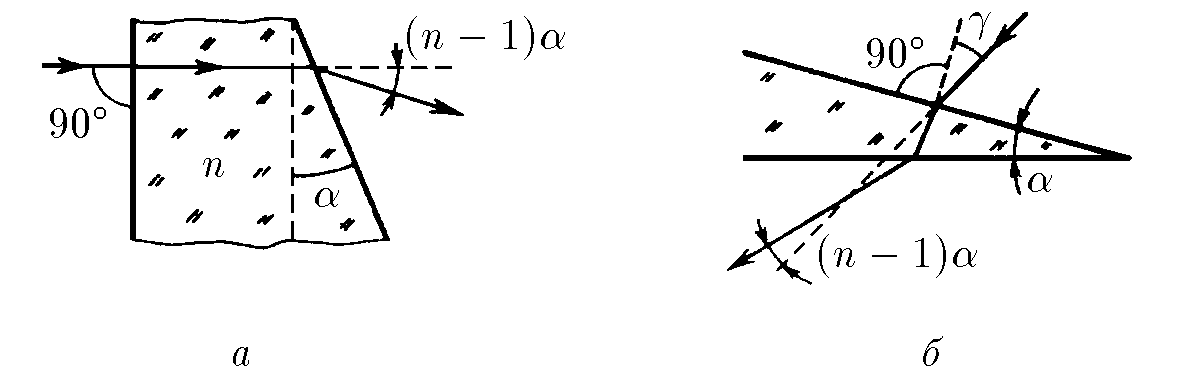
| $13.2.14.$ a. A light beam passes through a wedge with a small angle $\alpha$ at the vertex, | | $13.2.14.$ a. A light beam passes through a wedge with a small angle $\alpha$ at the vertex, |
| which is perpendicular to the front face of the wedge. Prove that the angle | | which is perpendicular to the front face of the wedge. Prove that the angle |
| of deflection of the ray from the initial direction is approximately $(n − 1) \alpha$. | | of deflection of the ray from the initial direction is approximately $(n − 1) \alpha$. |
| Refractive index of the wedge $n$. | | Refractive index of the wedge $n$. |
| b. A light ray passes through a wedge with a small angle $\alpha$ at the vertex, | | b. A light ray passes through a wedge with a small angle $\alpha$ at the vertex, |
| which falls at a small angle $\gamma$ to the normal to the front surface of the wedge. | | which falls at a small angle $\gamma$ to the normal to the front surface of the wedge. |
| Prove that the angle of deflection of the light beam from the initial direction | | Prove that the angle of deflection of the light beam from the initial direction |
| is approximately $(n − 1) \alpha$. Refractive index of the wedge $n$. | | is approximately $(n − 1) \alpha$. Refractive index of the wedge $n$. |
| c. Print the formula for the focal length of a thin lens. The radii of curvature | | c. Print the formula for the focal length of a thin lens. The radii of curvature |
| of the lens surface are $R_1$ and $R_2$, and the refractive index of the lens material | | of the lens surface are $R_1$ and $R_2$, and the refractive index of the lens material |
| is $n$. | | is $n$. |
| | | |
|  | |  |
| | | |
| ### Solution | | ### Solution |
| | | |
| #### 1. Hitting the first surface | | #### 1. Hitting the first surface |
| | | |
| Let's imagine there is a parallel lays of light entering the lens with refractive index $n_1$ from media with refractive index $n_0$, and after lens there is a media with refractive index $n_2$. | | Let's imagine there is a parallel lays of light entering the lens with refractive index $n_1$ from media with refractive index $n_0$, and after lens there is a media with refractive index $n_2$. |
| | | |
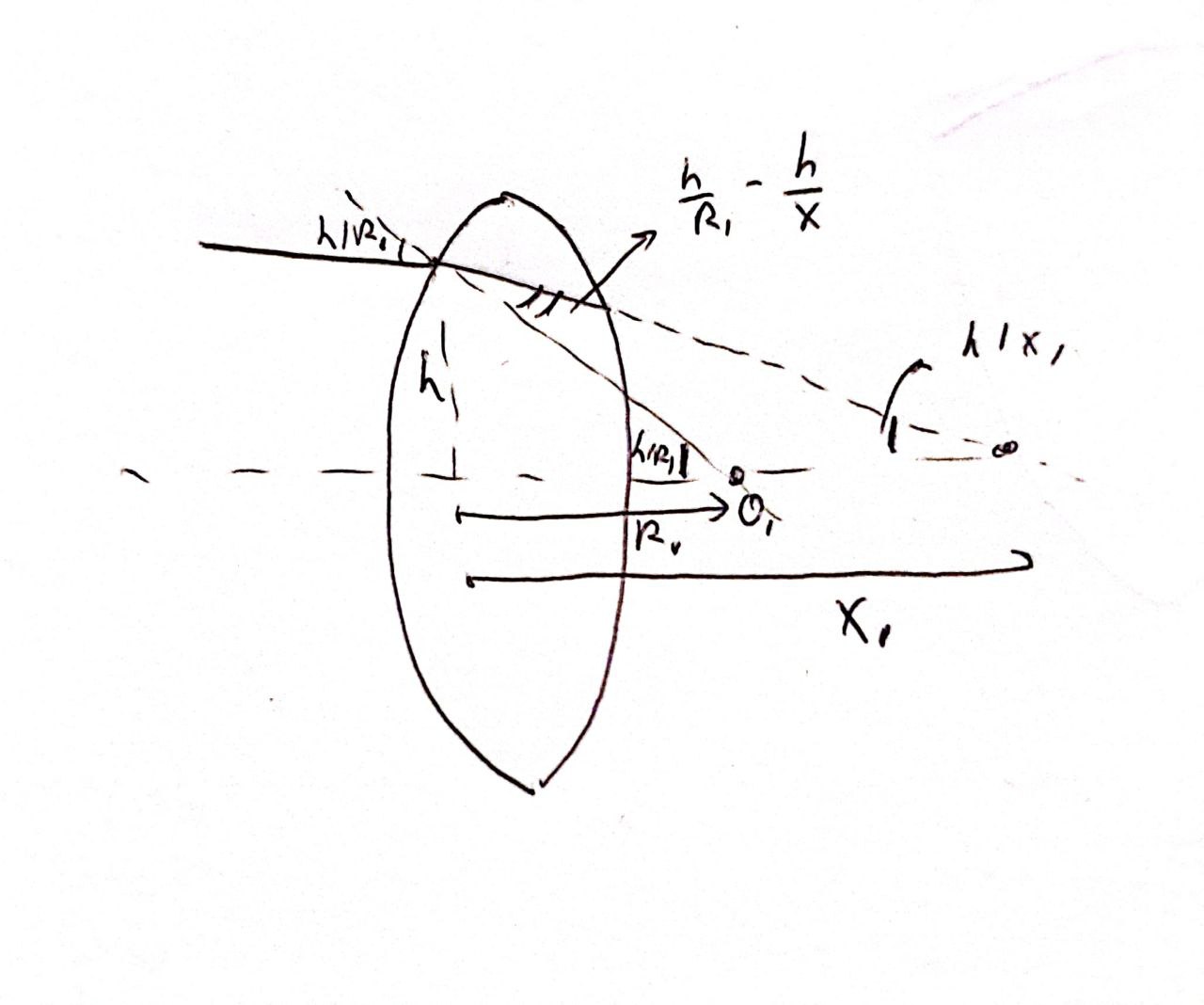
| First, let's consider the moment when ray hits front of lens at the point $h$ above optical axis. | | First, let's consider the moment when ray hits front of lens at the point $h$ above optical axis. |
| | | |
|  | |  |
| | | |
| As shown in the picture, the incidence angle is $$\tan(\alpha) \approx \frac{h}{R_1} \approx sin{(\alpha)} \approx \alpha$$ | | As shown in the picture, the incidence angle is $$\tan(\alpha) \approx \frac{h}{R_1} \approx sin{(\alpha)} \approx \alpha$$ |
| where $R_1$ is the curvature radius of first surface. | | where $R_1$ is the curvature radius of first surface. |
| | | |
| If there wasn't second surface, the ray after refraction will cross the optical axis at point $x_1$, and angle is $\tan(b) \approx \sin(\beta) \approx \beta = x_1/h$. So, the refraction angle is | | If there wasn't second surface, the ray after refraction will cross the optical axis at point $x_1$, and angle is $\tan(b) \approx \sin(\beta) \approx \beta = x_1/h$. So, the refraction angle is |
| $$ \alpha - \beta = \frac{h}{R_1} - \frac{h}{x_1}$$ | | $$ \alpha - \beta = \frac{h}{R_1} - \frac{h}{x_1}$$ |
| And by Snell's law: | | And by Snell's law: |
| $$n_0 \cdot \frac{h}{R_1} = n_1 \cdot \left(\frac{h}{R_1} - \frac{h}{R_2}\right)$$ | | $$n_0 \cdot \frac{h}{R_1} = n_1 \cdot \left(\frac{h}{R_1} - \frac{h}{R_2}\right)$$ |
| | | |
| #### 2. Hitting the second surface | | #### 2. Hitting the second surface |
| | | |
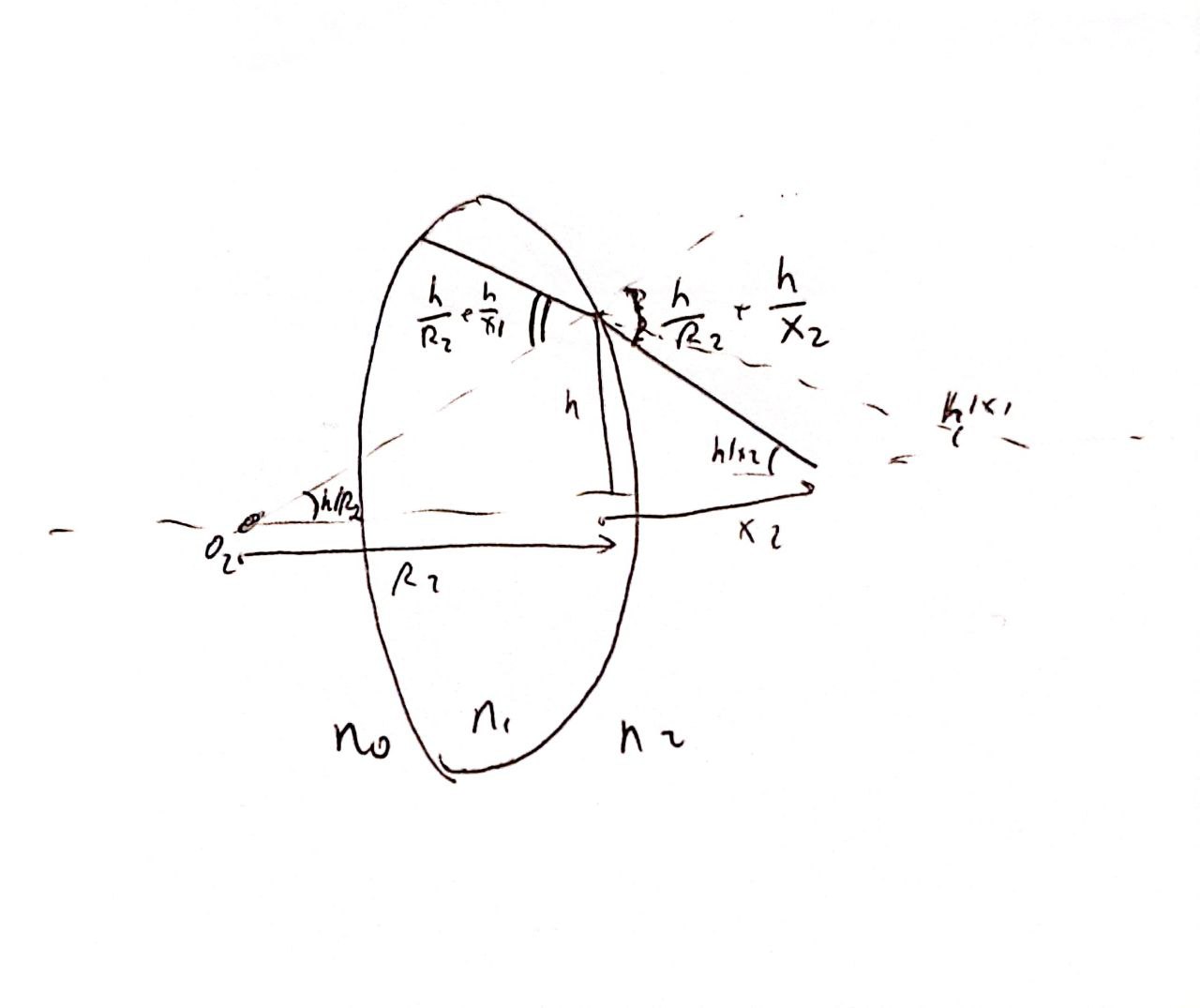
| After hitting the second surface, the ray will cross the axis at point $x_2$, which we want to find. | | After hitting the second surface, the ray will cross the axis at point $x_2$, which we want to find. |
| | | |
|  | |  |
| | | |
| The incidence angle is | | The incidence angle is |
| $$ | | $$ |
| \alpha_2 = \frac{h}{R_2} + \frac{h}{x_1} | | \alpha_2 = \frac{h}{R_2} + \frac{h}{x_1} |
| $$ | | $$ |
| And the refraction angle is | | And the refraction angle is |
| $$ | | $$ |
| \beta_2 = \frac{h}{R_2} + \frac{h}{x_2} | | \beta_2 = \frac{h}{R_2} + \frac{h}{x_2} |
| $$ | | $$ |
| By Snell's Law: | | By Snell's Law: |
| $$ | | $$ |
| n_1 \cdot \alpha_2 = n_2 \cdot \beta_2 | | n_1 \cdot \alpha_2 = n_2 \cdot \beta_2 |
| $$ | | $$ |
| Therefore: | | Therefore: |
| $$ | | $$ |
| n_1 \cdot \left(\frac{h}{R_2} + \frac{h}{x_1} \right) = n_2 \cdot \left(\frac{h}{R_2} + \frac{h}{x_2} \right) | | n_1 \cdot \left(\frac{h}{R_2} + \frac{h}{x_1} \right) = n_2 \cdot \left(\frac{h}{R_2} + \frac{h}{x_2} \right) |
| $$ | | $$ |
| So, we have a system of equations: | | So, we have a system of equations: |
| $$\begin{cases} | | $$\begin{cases} |
| n_0 \cdot \frac{h}{R_1} = n_1 \cdot \left(\frac{h}{R_1} - \frac{h}{R_2}\right)\\ | | n_0 \cdot \frac{h}{R_1} = n_1 \cdot \left(\frac{h}{R_1} - \frac{h}{R_2}\right)\\ |
| n_1 \cdot \left(\frac{h}{R_2} + \frac{h}{x_1} \right) = n_2 \cdot \left(\frac{h}{R_2} + \frac{h}{x_2} \right) | | n_1 \cdot \left(\frac{h}{R_2} + \frac{h}{x_1} \right) = n_2 \cdot \left(\frac{h}{R_2} + \frac{h}{x_2} \right) |
| \end{cases} | | \end{cases} |
| $$ | | $$ |
| Solving it, we can find $\frac{1}{x_2}$: | | Solving it, we can find $\frac{1}{x_2}$: |
| $$ | | $$ |
| \frac{1}{x_2} = \left(\frac{n_1}{n_2} -1 \right) \cdot \frac{1}{R_2} + \left(\frac{n_1}{n_2} - \frac{n_0}{n_2} \right) \cdot \frac{1}{R_1} = \frac{1}{F} | | \frac{1}{x_2} = \left(\frac{n_1}{n_2} -1 \right) \cdot \frac{1}{R_2} + \left(\frac{n_1}{n_2} - \frac{n_0}{n_2} \right) \cdot \frac{1}{R_1} = \frac{1}{F} |
| $$ | | $$ |
| In this problem, we have $n_0 = n_2 = 1, n_1 = n$ | | In this problem, we have $n_0 = n_2 = 1, n_1 = n$ |