Правка разделов «Solution», «1) Kinematics», «2) Displacement of CM»

en/2.1.50.md
+5 −5
| ### Statement | |||
| $2.1.50.$ [Insert the problem statement] | |||
| ### Solution | |||
| @@ -6,7 +6,7 @@Solution | |||
|  | |||
| − | |||
| + | ### 1) Kinematics | ||
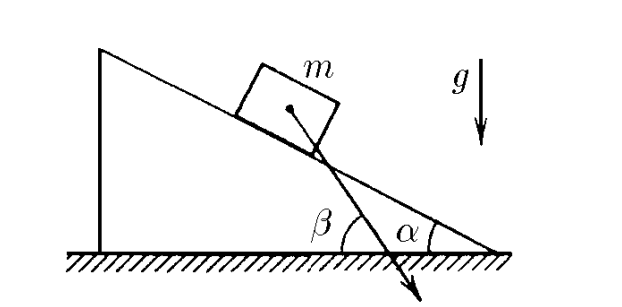
| Let us consider the instantaneous kinematics of the system.\\ | |||
| Let $M$ be the mass of the wedge.\\ | |||
| Let $V$ be the velocity of the wedge. \\ | |||
| Let $v$ be the velocity of the block relative to the wedge. | |||
| \vspace{6pt} \\ | |||
| The velocity components of the block relative to the ground are: | |||
| $$ v_x = v\cos{\alpha}-|V|, \qquad v_y= v\sin{\alpha}$$ | |||
| @@ -18,18 +18,18 @@1) Kinematics | |||
| From there we obtain \begin{equation} | |||
| \tan{\beta}=\frac{v\sin{\alpha}}{v\cos{\alpha}-|V|} | |||
| \end{equation} | |||
| − | |||
| + | ### 2) Displacement of CM | ||
| Since no force acts on the system horizontally, the horizontal displacement of the center of mass $\Delta x_{cm_x}$ must equal to 0, therefore we can write: | |||
| $$ \Delta x_{cm_x} = \frac{m \vec{\Delta x}_{mx}+M \vec{\Delta x}_{Mx}}{m +M} $$ \vspace{1pt} | |||
| $$0 = \frac{mv_x\Delta t - M|V| \Delta t}{m+M}$$ | |||
| − | | ||
| + | |||
| \begin{equation} | |||
| M|V|=m(v \cos{\alpha}-|V|) | |||
| \end{equation} | |||
| − | | ||
| + | |||
| $$|V|=\frac{mv\cos{\alpha}}{M+m}$$ | |||
| − | |||
| + | ### 3) Substitution | ||
| Now we substitute V into (1): | |||
| $$\tan{\beta}=\frac{v}{v-\frac{mv}{M+m}}\tan{\alpha}$$ | |||
| And obtain the following: \boldmath $$M=\frac{m\tan{\alpha}}{\tan{\beta} + \tan{\alpha}}$$ | |||
| #### Answer | |||
| $$M=\frac{m\tan{\alpha}}{\tan{\beta} + \tan{\alpha}}$$ | |||
| ещё строк без изменений 6 | |||
| ### Statement | ### Statement | ||
| $2.1.50.$ [Insert the problem statement] | $2.1.50.$ [Insert the problem statement] | ||
| ### Solution | ### Solution | ||
| @@ -6,7 +6,7 @@Solution | |||
|  |  | ||
| ### 1) Kinematics | |||
| Let us consider the instantaneous kinematics of the system.\\ | Let us consider the instantaneous kinematics of the system.\\ | ||
| Let $M$ be the mass of the wedge.\\ | Let $M$ be the mass of the wedge.\\ | ||
| Let $V$ be the velocity of the wedge. \\ | Let $V$ be the velocity of the wedge. \\ | ||
| Let $v$ be the velocity of the block relative to the wedge. | Let $v$ be the velocity of the block relative to the wedge. | ||
| \vspace{6pt} \\ | \vspace{6pt} \\ | ||
| The velocity components of the block relative to the ground are: | The velocity components of the block relative to the ground are: | ||
| $$ v_x = v\cos{\alpha}-|V|, \qquad v_y= v\sin{\alpha}$$ | $$ v_x = v\cos{\alpha}-|V|, \qquad v_y= v\sin{\alpha}$$ | ||
| @@ -18,18 +18,18 @@1) Kinematics | |||
| From there we obtain \begin{equation} | From there we obtain \begin{equation} | ||
| \tan{\beta}=\frac{v\sin{\alpha}}{v\cos{\alpha}-|V|} | \tan{\beta}=\frac{v\sin{\alpha}}{v\cos{\alpha}-|V|} | ||
| \end{equation} | \end{equation} | ||
| ### 2) Displacement of CM | |||
| Since no force acts on the system horizontally, the horizontal displacement of the center of mass $\Delta x_{cm_x}$ must equal to 0, therefore we can write: | Since no force acts on the system horizontally, the horizontal displacement of the center of mass $\Delta x_{cm_x}$ must equal to 0, therefore we can write: | ||
| $$ \Delta x_{cm_x} = \frac{m \vec{\Delta x}_{mx}+M \vec{\Delta x}_{Mx}}{m +M} $$ \vspace{1pt} | $$ \Delta x_{cm_x} = \frac{m \vec{\Delta x}_{mx}+M \vec{\Delta x}_{Mx}}{m +M} $$ \vspace{1pt} | ||
| $$0 = \frac{mv_x\Delta t - M|V| \Delta t}{m+M}$$ | $$0 = \frac{mv_x\Delta t - M|V| \Delta t}{m+M}$$ | ||
| |
|||
| \begin{equation} | \begin{equation} | ||
| M|V|=m(v \cos{\alpha}-|V|) | M|V|=m(v \cos{\alpha}-|V|) | ||
| \end{equation} | \end{equation} | ||
| |
|||
| $$|V|=\frac{mv\cos{\alpha}}{M+m}$$ | $$|V|=\frac{mv\cos{\alpha}}{M+m}$$ | ||
| ### 3) Substitution | |||
| Now we substitute V into (1): | Now we substitute V into (1): | ||
| $$\tan{\beta}=\frac{v}{v-\frac{mv}{M+m}}\tan{\alpha}$$ | $$\tan{\beta}=\frac{v}{v-\frac{mv}{M+m}}\tan{\alpha}$$ | ||
| And obtain the following: \boldmath $$M=\frac{m\tan{\alpha}}{\tan{\beta} + \tan{\alpha}}$$ | And obtain the following: \boldmath $$M=\frac{m\tan{\alpha}}{\tan{\beta} + \tan{\alpha}}$$ | ||
| #### Answer | #### Answer | ||
| $$M=\frac{m\tan{\alpha}}{\tan{\beta} + \tan{\alpha}}$$ | $$M=\frac{m\tan{\alpha}}{\tan{\beta} + \tan{\alpha}}$$ | ||
| ещё строк без изменений 6 | |||