| @@ -1,13 +1,13 @@ |
| ### Statement |
| ### Statement |
| |
| |
| $2.1.50.$ On a smooth horizontal plane there is a wedge with an angle $α$ at the base. A |
| $2.1.50.$ On a smooth horizontal plane there is a wedge with an angle $α$ at the base. A |
| body of mass $m$ placed on a wedge descends with acceleration directed at an |
| body of mass $m$ placed on a wedge descends with acceleration directed at an |
| angle $β > α$ to the horizontal. Determine the mass of the wedge |
| angle $β > α$ to the horizontal. Determine the mass of the wedge |
| 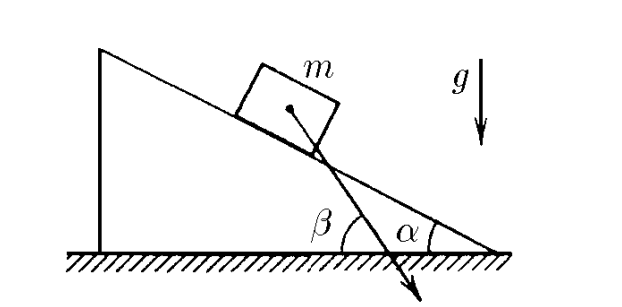 |
|  |
| |
| |
| ### Solution |
| ### Solution |
| |
| |
| /scan-0.png) |
|  |
| |
| |
| |
| |
| #### 1) Kinematics |
| #### 1) Kinematics |
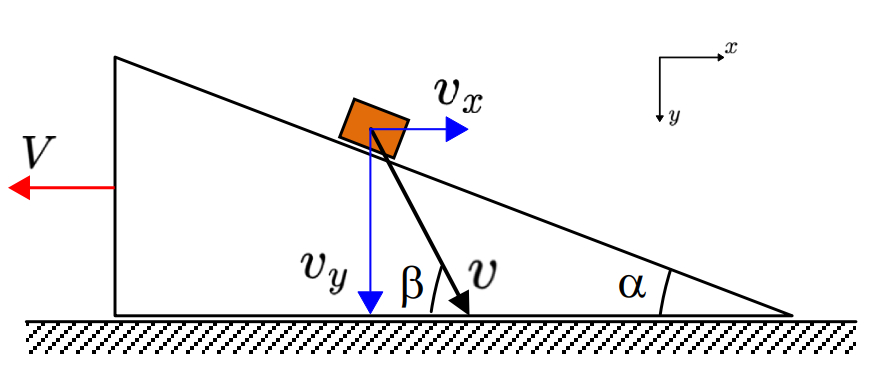
| Let us consider the instantaneous kinematics of the system.\ | | Let us consider the instantaneous kinematics of the system.\ |
| Let $M$ be the mass of the wedge.\ | | Let $M$ be the mass of the wedge.\ |
| Let $V$ be the velocity of the wedge. \ | | Let $V$ be the velocity of the wedge. \ |
| Let $v$ be the velocity of the block relative to the wedge. | | Let $v$ be the velocity of the block relative to the wedge. |
| | | |
| \ | | \ |
| The velocity components of the block relative to the ground are: | | The velocity components of the block relative to the ground are: |
| $$ v_x = v\cos{\alpha}-|V|, \qquad v_y= v\sin{\alpha}$$ | | $$ v_x = v\cos{\alpha}-|V|, \qquad v_y= v\sin{\alpha}$$ |
| | | |
| From there we obtain \begin{equation} | | From there we obtain \begin{equation} |
| \tan{\beta}=\frac{v\sin{\alpha}}{v\cos{\alpha}-|V|} | | \tan{\beta}=\frac{v\sin{\alpha}}{v\cos{\alpha}-|V|} |
| \end{equation} | | \end{equation} |
| #### 2) Displacement of CM | | #### 2) Displacement of CM |
| Since no force acts on the system horizontally, the horizontal displacement of the center of mass $\Delta x_{cm_x}$ must equal to 0, therefore we can write: | | Since no force acts on the system horizontally, the horizontal displacement of the center of mass $\Delta x_{cm_x}$ must equal to 0, therefore we can write: |
| | | |
| $$ \Delta x_{cm_x} = \frac{m \vec{\Delta x}_{mx}+M \vec{\Delta x}_{Mx}}{m +M} $$ | | $$ \Delta x_{cm_x} = \frac{m \vec{\Delta x}_{mx}+M \vec{\Delta x}_{Mx}}{m +M} $$ |
| $$0 = \frac{mv_x\Delta t - M|V| \Delta t}{m+M}$$ | | $$0 = \frac{mv_x\Delta t - M|V| \Delta t}{m+M}$$ |
| \begin{equation} | | \begin{equation} |
| M|V|=m(v \cos{\alpha}-|V|) | | M|V|=m(v \cos{\alpha}-|V|) |
| \end{equation} | | \end{equation} |
| | | |
| $$|V|=\frac{mv\cos{\alpha}}{M+m}$$ | | $$|V|=\frac{mv\cos{\alpha}}{M+m}$$ |
| #### 3) Substitution | | #### 3) Substitution |
| Now we substitute V into (1): | | Now we substitute V into (1): |
| $$\tan{\beta}=\frac{v}{v-\frac{mv}{M+m}}\tan{\alpha}$$ | | $$\tan{\beta}=\frac{v}{v-\frac{mv}{M+m}}\tan{\alpha}$$ |
| And obtain the following: \boldmath $$M=\frac{m\tan{\alpha}}{\tan{\beta} + \tan{\alpha}}$$ | | And obtain the following: \boldmath $$M=\frac{m\tan{\alpha}}{\tan{\beta} + \tan{\alpha}}$$ |
| | | |
| | | |
| | | |
| #### Answer | | #### Answer |
| | | |
| $$M=\frac{m\tan{\alpha}}{\tan{\beta} + \tan{\alpha}}$$ | | $$M=\frac{m\tan{\alpha}}{\tan{\beta} + \tan{\alpha}}$$ |
