Новое решение

en/3.5.25.md
+21 −0
| @@ -0,0 +1,21 @@ | |||
| + | ### Statement | ||
| + | |||
| + | $3.5.25.$ [Insert the problem statement] | ||
| + | |||
| + | ### Solution | ||
| + | |||
| + |  | ||
| + | |||
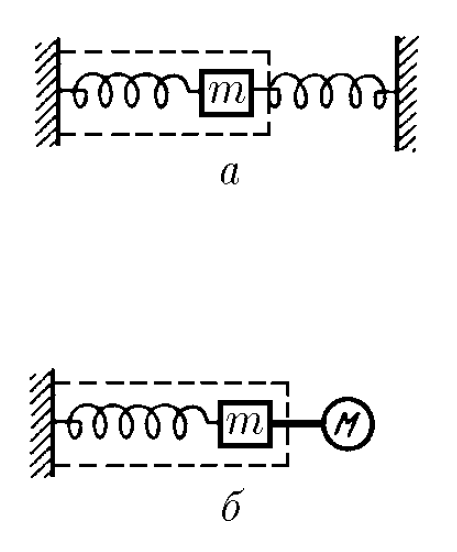
| + | The purpose of this exercise is to show that results obtained by considering mass $m$ and the left spring as a single oscillator are consistent with those obtained by considering mass $m$ alone in the top figure or masses $m$ and $M$ together in the bottom figure. | ||
| + | |||
| + | In the top figure, the forces acting on the oscillator are from the left wall and the right spring. If the displacement of mass $m$ from equilibrium is $x$, then the force from the left wall is $-kx$ (as the left spring exerts the force $kx$ on the left wall). Similarly, the force from the right spring is $-kx$, and the total force on the oscillator is $-2kx$. As $m\ddot x=-2kx$, the motion is harmonic in nature and consistent with what we would have obtained had we considered mass $m$ alone. | ||
| + | |||
| + | In the bottom figure, the forces acting on the oscillator are from the left wall and the rod connecting to mass $M$. If the displacement of mass $m$ from equilibrium is $x$, then the force from the left wall is $-kx$. On the other hand, mass $M$ moves with acceleration $\ddot x$ and experiences the force $M\ddot x$ from the rod. Consequently, the rod exerts the force $-M\ddot x$ on the oscillator, and the total force on the oscillator is $-kx-M\ddot x$. As | ||
| + | |||
| + | \[m\ddot x=-kx-M\ddot x\qquad\Rightarrow\qquad(m+M)\ddot x=-kx,\] | ||
| + | |||
| + | the motion is harmonic in nature and consistent with what we would have obtained had we considered masses $m$ and $M$ together. | ||
| + | |||
| + | #### Answer | ||
| + | |||
| + | [Insert a concise answer or boxed result] | ||
| @@ -0,0 +1,21 @@ | |||
| ### Statement | |||
| $3.5.25.$ [Insert the problem statement] | |||
| ### Solution | |||
|  | |||
| The purpose of this exercise is to show that results obtained by considering mass $m$ and the left spring as a single oscillator are consistent with those obtained by considering mass $m$ alone in the top figure or masses $m$ and $M$ together in the bottom figure. | |||
| In the top figure, the forces acting on the oscillator are from the left wall and the right spring. If the displacement of mass $m$ from equilibrium is $x$, then the force from the left wall is $-kx$ (as the left spring exerts the force $kx$ on the left wall). Similarly, the force from the right spring is $-kx$, and the total force on the oscillator is $-2kx$. As $m\ddot x=-2kx$, the motion is harmonic in nature and consistent with what we would have obtained had we considered mass $m$ alone. | |||
| In the bottom figure, the forces acting on the oscillator are from the left wall and the rod connecting to mass $M$. If the displacement of mass $m$ from equilibrium is $x$, then the force from the left wall is $-kx$. On the other hand, mass $M$ moves with acceleration $\ddot x$ and experiences the force $M\ddot x$ from the rod. Consequently, the rod exerts the force $-M\ddot x$ on the oscillator, and the total force on the oscillator is $-kx-M\ddot x$. As | |||
| \[m\ddot x=-kx-M\ddot x\qquad\Rightarrow\qquad(m+M)\ddot x=-kx,\] | |||
| the motion is harmonic in nature and consistent with what we would have obtained had we considered masses $m$ and $M$ together. | |||
| #### Answer | |||
| [Insert a concise answer or boxed result] | |||