Решение на момент правки #19864 от , автор Valter. Это не текущая версия.

Statement

5.5.4∗. A slab of mass is placed on two long cylindrical bags of radius and length , made of an inextensible material and filled with gas. As a result, they are flattened to a thickness of . The external pressure is . Determine the initial pressure in the bags if the temperature of the gas in them did not change.
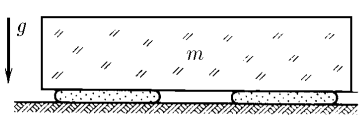
For problem $5.5.4$
For problem

Solution

Since the material of the bags is inextensible, the perimeter of their cross-section does not change during deformation. Initially, the perimeter of one bag is .

After the slab is placed on them, the bags are flattened to a thickness of . In this flattened state, the cross-section of the bag can be approximated as a rectangle with width and height . The perimeter of this cross-section is . Using the condition , we can neglect , so the perimeter is approximately .
Equating the initial and final perimeters:

Now we can write down the initial and final volumes for one bag:
Initial volume:
Final volume:

The slab of mass rests on two bags. The total horizontal contact area of the slab with both bags is:

In a state of mechanical equilibrium, the force of gravity acting on the slab is balanced by the difference between the force from the gas pressure inside the bags () and the external atmospheric pressure () acting on this contact area:

From this, we express the final pressure in the bags:

According to the problem statement, the gas temperature does not change ().

Crucial Note

When applying the ideal gas law (and its consequence, Boyle's Law), we must use absolute pressure, not gauge (excess) pressure. Gas compressibility inherently depends on the total pressure acting on the molecules. Attempting to use only the gauge pressure () and adding the atmospheric pressure later as a constant is mathematically invalid for systems with large volume changes (). This flawed superposition principle ignores the massive thermodynamic work done by the atmosphere during the compression.

Applying Boyle's Law for the initial and final states of the gas inside one bag:

Substituting the expressions for the volumes:

Substituting the expression for into this equation and expanding the brackets:

Answer

The answer provided in the official problem book is . This result is derived by incorrectly applying Boyle's Law only to the gauge pressure and adding the atmospheric pressure at the end. As demonstrated in the note above, this mathematical approach is valid only if the volume of the gas remains constant (). Since the bags are heavily flattened (), using this superposition principle directly violates the ideal gas law, rendering the official answer physically incorrect.