| @@ -1,31 +1,41 @@ |
| | − | ### Statement |
| | + | ### Statement |
| | | |
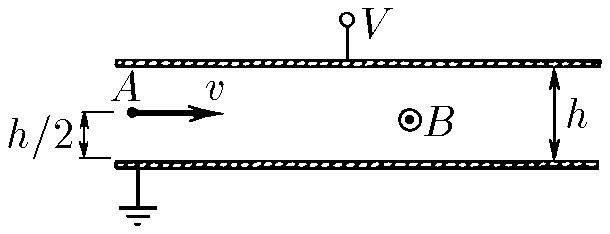
| | − | $10.2.8$ A plane capacitor is placed in a homogeneous magnetic field od induction $B$ parallel to the plates. From point A, electrons enter perpendicularly to magnetic field direction. The tension (voltage) applied to the plates is $V$. What is the condition for which electrons pass through the capacitor? |
| | + | $10.2.8.$ A plane capacitor is placed in a uniform magnetic field of induction $B$ parallel to the plates. From point A, electrons enter in a direction perpendicular to the magnetic field. The voltage applied to the plates is $V$. Under what condition will the electrons pass through the capacitor? |
| | | |
| | − |  |
| | − | |
| | | ### Solution |
| | | |
| | − | Electrons pass through capacitor if they don't collide with plates. So, supposing a capacitor of infinite length, electron's velocity must be parallel to the plates (or its horizontal range over a plate greater than its enter's height). This is possible if electric and magnetic forces are in equilibrium (equal absolute values and opposed directions). |
| | + | The solution presented in some sources solely considers the device as a "velocity selector" where electric and magnetic forces perfectly cancel each other out ($evB = eE$), resulting in straight-line motion. However, this is only a special case. To find the *full* range of conditions, we must analyze the electron's dynamics, assuming an infinitely long capacitor where the electron must not hit the plates. |
| | | |
| | − | $$ |
| | − | evB = eE |
| | − | $$ |
| | + | Let's establish a coordinate system: the $x$-axis is directed along the initial velocity $v$ (to the right), the $y$-axis is directed vertically upwards, and the magnetic field $\vec{B}$ is along the $z$-axis (pointing towards us). |
| | + | The electric field $E = V/h$. For an electron (charge $-e$) to have a chance to pass, the electric force must oppose the upward magnetic Lorentz force, meaning the vector $\vec{E}$ must be directed upwards. |
| | | |
| | − | $$ |
| | − | v = \frac{E}{B} |
| | − | $$ |
| | + | Let's write the equations of motion (Newton's second law projections) for an electron of mass $m_e$. |
| | + | Along the $x$-axis, the only force is the projection of the magnetic force arising from the vertical velocity component: |
| | + | $$m_e \frac{dv_x}{dt} = -eB v_y = -eB \frac{dy}{dt}$$ |
| | | |
| | − | As $E=\frac{V}{h}$, |
| | + | Multiplying by $dt$ and integrating with initial conditions (at $y = 0$, $v_x = v$): |
| | + | $$m_e(v_x - v) = -eBy \implies v_x = v - \frac{eB}{m_e}y \quad (1)$$ |
| | | |
| | − | $$ |
| | − | \boxed{v = \frac{V}{Bh}} |
| | − | $$ |
| | + | Along the $y$-axis, the electron experiences both the downward electric force and the magnetic force from the horizontal velocity: |
| | + | $$m_e \frac{dv_y}{dt} = eB v_x - eE$$ |
| | | |
| | − | This device is known as speed's selector. |
| | + | Substitute $v_x$ from equation $(1)$: |
| | + | $$m_e \frac{dv_y}{dt} = eB \left( v - \frac{eB}{m_e}y \right) - eE = e(Bv - E) - \frac{e^2B^2}{m_e}y$$ |
| | | |
| | + | This equation describes a harmonic oscillator. Let's find the equilibrium coordinate $y_0$ where the vertical acceleration is zero: |
| | + | $$e(Bv - E) - \frac{e^2B^2}{m_e}y_0 = 0 \implies y_0 = \frac{m_e(Bv - E)}{eB^2}$$ |
| | | |
| | + | Since the electron enters the capacitor at $y = 0$ with zero vertical velocity, this point is an extreme point of its oscillation. The maximum deflection from the central axis will be: |
| | + | $$y_{max} = 2y_0 = \frac{2m_e(Bv - E)}{eB^2}$$ |
| | | |
| | + | For the electron to pass through the capacitor without hitting the plates, its maximum absolute deflection must not exceed half the distance between the plates: |
| | + | $$|y_{max}| \le \frac{h}{2}$$ |
| | + | $$\left| \frac{2m_e(Bv - E)}{eB^2} \right| \le \frac{h}{2}$$ |
| | | |
| | + | Substituting $E = V/h$ and dividing the term inside the modulus by $B$, we obtain the final condition for the initial velocity $v$: |
| | + | $$\left| v - \frac{V}{Bh} \right| \le \frac{eBh}{4m_e}$$ |
| | | |
| | + | *Note: The trivial straight-line case $v = V/(Bh)$ mentioned in simplified solutions corresponds to the center of this valid velocity range, where the amplitude of oscillations is zero.* |
| | | |
| | + | #### Answer |
| | + | $$\left| v - \frac{V}{Bh} \right| \le \frac{eBh}{4m_e}$$ |
