Новое решение

en/2.5.23.md
+29 −0
| @@ -0,0 +1,29 @@ | |||
| + | ### Statement | ||
| + | |||
| + | $2.5.23.$ [Insert the problem statement] | ||
| + | |||
| + | ### Solution | ||
| + | |||
| + |  | ||
| + | |||
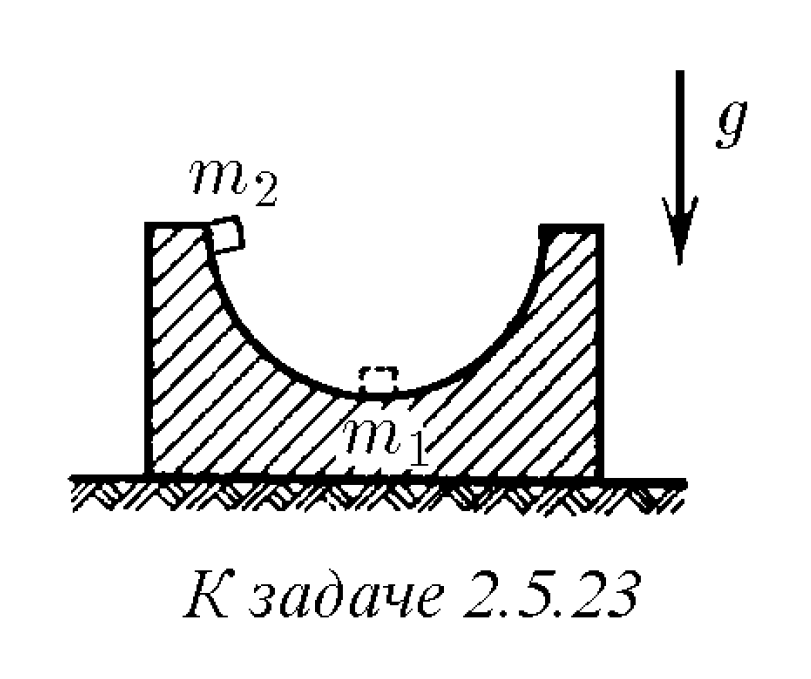
| + | Suppose that the speed of the body at its lowest point is $v_2$ and the speed of the support moving in the opposite direction is $v_1$. Then, by conservation of momentum $m_1v_1=m_2v_2$, because both objects are initially at rest. From conservation of energy, the gravitational potential energy of the body transforms into kinetic energy of both objects, so | ||
| + | |||
| + | \[\frac{1}{2}m_1v_1^2+\frac{1}{2}m_2v_2^2=m_2gR.\] | ||
| + | |||
| + | Solving the two equations from conservation laws, we have | ||
| + | |||
| + | \[v_1=\frac{m_2}{m_1}\cdot\sqrt{\frac{2m_1gR}{m_1+m_2}},\qquad v_2=\sqrt{\frac{2m_1gR}{m_1+m_2}}.\] | ||
| + | |||
| + | The body moves along a circular path relative to the support, and its relative speed at its lowest point is | ||
| + | |||
| + | \[v=v_1+v_2=\sqrt{\frac{2(m1+m_2)gR}{m_1}}.\] | ||
| + | |||
| + | At this point, the centripetal force is $N-m_2g$, where $N$ is the normal force on the body from the support (which has the same magnitude as the force that the body exerts on the support). Consequently, | ||
| + | |||
| + | \[N=m_2g+\frac{m_2v^2}{R}=\frac{m_2(3m_1+2m_2)g}{m_1}.\] | ||
| + | |||
| + | Note that while the support is a non-inertial frame of reference, the pseudo-force in this frame is horizontal and does not affect $N$. | ||
| + | |||
| + | #### Answer | ||
| + | |||
| + | [Insert a concise answer or boxed result] | ||
| @@ -0,0 +1,29 @@ | |||
| ### Statement | |||
| $2.5.23.$ [Insert the problem statement] | |||
| ### Solution | |||
|  | |||
| Suppose that the speed of the body at its lowest point is $v_2$ and the speed of the support moving in the opposite direction is $v_1$. Then, by conservation of momentum $m_1v_1=m_2v_2$, because both objects are initially at rest. From conservation of energy, the gravitational potential energy of the body transforms into kinetic energy of both objects, so | |||
| \[\frac{1}{2}m_1v_1^2+\frac{1}{2}m_2v_2^2=m_2gR.\] | |||
| Solving the two equations from conservation laws, we have | |||
| \[v_1=\frac{m_2}{m_1}\cdot\sqrt{\frac{2m_1gR}{m_1+m_2}},\qquad v_2=\sqrt{\frac{2m_1gR}{m_1+m_2}}.\] | |||
| The body moves along a circular path relative to the support, and its relative speed at its lowest point is | |||
| \[v=v_1+v_2=\sqrt{\frac{2(m1+m_2)gR}{m_1}}.\] | |||
| At this point, the centripetal force is $N-m_2g$, where $N$ is the normal force on the body from the support (which has the same magnitude as the force that the body exerts on the support). Consequently, | |||
| \[N=m_2g+\frac{m_2v^2}{R}=\frac{m_2(3m_1+2m_2)g}{m_1}.\] | |||
| Note that while the support is a non-inertial frame of reference, the pseudo-force in this frame is horizontal and does not affect $N$. | |||
| #### Answer | |||
| [Insert a concise answer or boxed result] | |||