Правка разделов «Statement», «Solution», «Answer»

en/2.5.23.md
+6 −4
| @@ -1,10 +1,10 @@ | |||
| ### Statement | |||
| − | $2.5.23.$ [Insert the problem statement] | ||
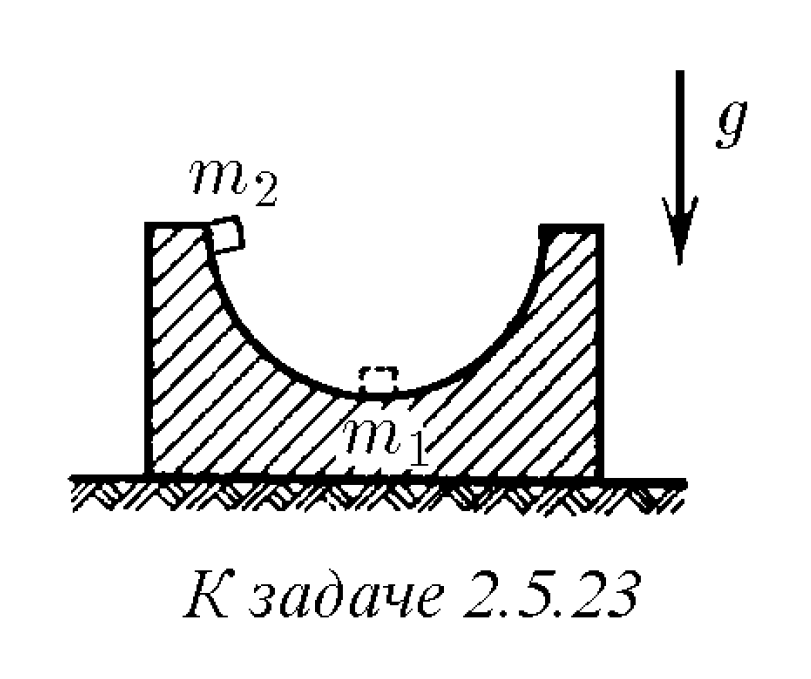
| + | $2.5.23.$ A support of mass $m_1$ with a hemispherical recess of radius $R$ stands on a smooth table. The body of mass $m_2$ is placed on the edge of the recess and released. Find the velocity of the body and the support at the moment when the body passes the lower point of the hemisphere. How much pressure does it exert on the stand at this point? Ignore the friction. | ||
| ### Solution | |||
| − |  | ||
| Suppose that the speed of the body at its lowest point is $v_2$ and the speed of the support moving in the opposite direction is $v_1$. Then, by conservation of momentum $m_1v_1=m_2v_2$, because both objects are initially at rest. From conservation of energy, the gravitational potential energy of the body transforms into kinetic energy of both objects, so | |||
| \[\frac{1}{2}m_1v_1^2+\frac{1}{2}m_2v_2^2=m_2gR.\] | |||
| Solving the two equations from conservation laws, we have | |||
| \[v_1=\frac{m_2}{m_1}\cdot\sqrt{\frac{2m_1gR}{m_1+m_2}},\qquad v_2=\sqrt{\frac{2m_1gR}{m_1+m_2}}.\] | |||
| @@ -16,7 +16,7 @@Solution | |||
| The body moves along a circular path relative to the support, and its relative speed at its lowest point is | |||
| − | \[v=v_1+v_2=\sqrt{\frac{2(m1+m_2)gR}{m_1}}.\] | ||
| + | \[v=v_1+v_2=\sqrt{\frac{2(m_1+m_2)gR}{m_1}}.\] | ||
| At this point, the centripetal force is $N-m_2g$, where $N$ is the normal force on the body from the support (which has the same magnitude as the force that the body exerts on the support). Consequently, | |||
| \[N=m_2g+\frac{m_2v^2}{R}=\frac{m_2(3m_1+2m_2)g}{m_1}.\] | |||
| Note that while the support is a non-inertial frame of reference, the pseudo-force in this frame is horizontal and does not affect $N$. | |||
| @@ -26,4 +26,6 @@Solution | |||
| #### Answer | |||
| − | [Insert a concise answer or boxed result] | ||
| + | $v_1=\frac{m_2}{m_1}\cdot\sqrt{\frac{2m_1gR}{m_1+m_2}}$ and $v_2=\sqrt{\frac{2m_1gR}{m_1+m_2}}$ | ||
| + | |||
| + | $N=\frac{m_2(3m_1+2m_2)g}{m_1}$ | ||
| @@ -1,10 +1,10 @@ | |||
| ### Statement | ### Statement | ||
| $2.5.23.$ [Insert the problem statement] | $2.5.23.$ A support of mass $m_1$ with a hemispherical recess of radius $R$ stands on a smooth table. The body of mass $m_2$ is placed on the edge of the recess and released. Find the velocity of the body and the support at the moment when the body passes the lower point of the hemisphere. How much pressure does it exert on the stand at this point? Ignore the friction. | ||
| ### Solution | ### Solution | ||
|  | ||
| Suppose that the speed of the body at its lowest point is $v_2$ and the speed of the support moving in the opposite direction is $v_1$. Then, by conservation of momentum $m_1v_1=m_2v_2$, because both objects are initially at rest. From conservation of energy, the gravitational potential energy of the body transforms into kinetic energy of both objects, so | Suppose that the speed of the body at its lowest point is $v_2$ and the speed of the support moving in the opposite direction is $v_1$. Then, by conservation of momentum $m_1v_1=m_2v_2$, because both objects are initially at rest. From conservation of energy, the gravitational potential energy of the body transforms into kinetic energy of both objects, so | ||
| \[\frac{1}{2}m_1v_1^2+\frac{1}{2}m_2v_2^2=m_2gR.\] | \[\frac{1}{2}m_1v_1^2+\frac{1}{2}m_2v_2^2=m_2gR.\] | ||
| Solving the two equations from conservation laws, we have | Solving the two equations from conservation laws, we have | ||
| \[v_1=\frac{m_2}{m_1}\cdot\sqrt{\frac{2m_1gR}{m_1+m_2}},\qquad v_2=\sqrt{\frac{2m_1gR}{m_1+m_2}}.\] | \[v_1=\frac{m_2}{m_1}\cdot\sqrt{\frac{2m_1gR}{m_1+m_2}},\qquad v_2=\sqrt{\frac{2m_1gR}{m_1+m_2}}.\] | ||
| @@ -16,7 +16,7 @@Solution | |||
| The body moves along a circular path relative to the support, and its relative speed at its lowest point is | The body moves along a circular path relative to the support, and its relative speed at its lowest point is | ||
| \[v=v_1+v_2=\sqrt{\frac{2(m1+m_2)gR}{m_1}}.\] | \[v=v_1+v_2=\sqrt{\frac{2(m_1+m_2)gR}{m_1}}.\] | ||
| At this point, the centripetal force is $N-m_2g$, where $N$ is the normal force on the body from the support (which has the same magnitude as the force that the body exerts on the support). Consequently, | At this point, the centripetal force is $N-m_2g$, where $N$ is the normal force on the body from the support (which has the same magnitude as the force that the body exerts on the support). Consequently, | ||
| \[N=m_2g+\frac{m_2v^2}{R}=\frac{m_2(3m_1+2m_2)g}{m_1}.\] | \[N=m_2g+\frac{m_2v^2}{R}=\frac{m_2(3m_1+2m_2)g}{m_1}.\] | ||
| Note that while the support is a non-inertial frame of reference, the pseudo-force in this frame is horizontal and does not affect $N$. | Note that while the support is a non-inertial frame of reference, the pseudo-force in this frame is horizontal and does not affect $N$. | ||
| @@ -26,4 +26,6 @@Solution | |||
| #### Answer | #### Answer | ||
| [Insert a concise answer or boxed result] | $v_1=\frac{m_2}{m_1}\cdot\sqrt{\frac{2m_1gR}{m_1+m_2}}$ and $v_2=\sqrt{\frac{2m_1gR}{m_1+m_2}}$ | ||
| $N=\frac{m_2(3m_1+2m_2)g}{m_1}$ | |||