Statement
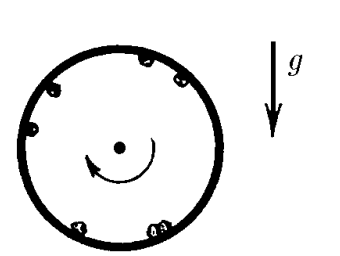
2.1.67∗. At what minimum angular velocity should a horizontally located cylinder rotate around its axis so that small particles inside the cylinder do not slide off its inner surface? The coefficient of friction between the cylinder surface and the particles is
Solution
Let's consider a particle on the inner wall of the rotating cylinder at an angle
According to Newton's second law for the radial direction, the centripetal acceleration is provided by the normal reaction force
For the particle not to slide down along the inner wall, the required static friction force must balance the tangential component of gravity (
To prevent sliding, this required friction force must not exceed the maximum possible static friction force (
Substitute the expression for the normal force
According to the problem statement, the coefficient of friction is
To ensure the particles do not slide at any point on the inner surface of the cylinder, this condition must hold true for the maximum possible value of the function
Using trigonometric properties, the maximum value of
Therefore, the minimum angular velocity required to hold the particles at all points is determined by: