+
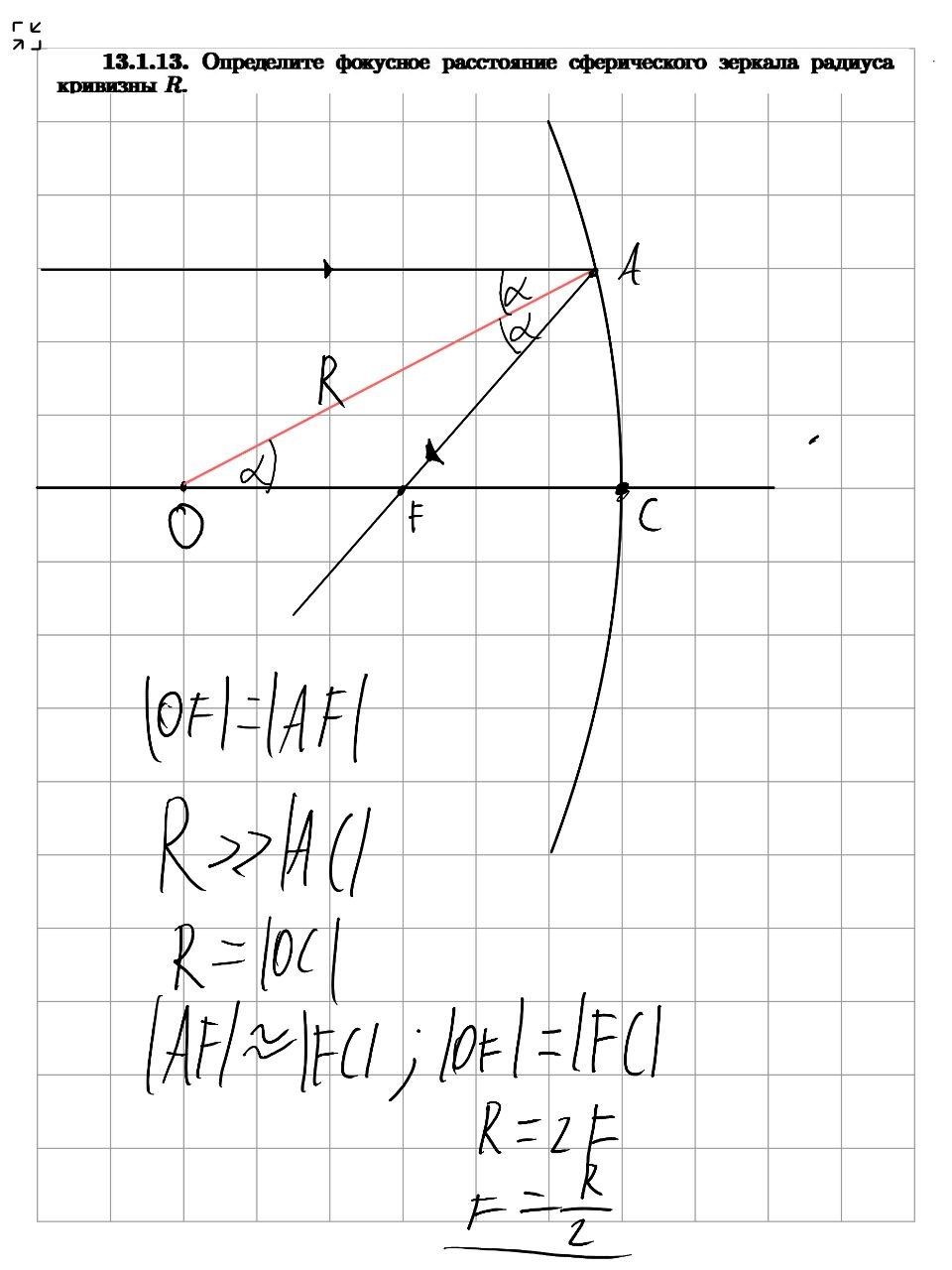
Consider a ray parallel to the principal optical axis incident on a spherical mirror at point $A$.
−
Here it was used that h' = 0, no matter what the original h value is. Since the incident height does not change where the ray converges. I would also like to note, that I made a small error, For a light ray travelling at an angle, I wrote sin(β), it is supposed to be tan(β), but we can still use the small angle approximation. So it doesn't change the result.
+
The radius of the mirror $OA = R$ is the normal to the surface at the point of incidence. According to the law of reflection, the angle of incidence equals the angle of reflection: $\angle (\text{incident ray}, OA) = \angleOAF = \alpha$.
+
Since the incident ray is parallel to the principal optical axis $OC$, the alternate interior angle $\angle AOF$ is also equal to $\alpha$.
+
+
Therefore, triangle $\triangle AOF$ is isosceles, which implies:
+
$$ |OF| = |AF| $$
+
+
Let us drop a perpendicular from point $F$ to the segment $OA$. In an isosceles triangle, this perpendicular also acts as a median, hence:

Consider a ray parallel to the principal optical axis incident on a spherical mirror at point $A$.
Here it was used that h' = 0, no matter what the original h value is. Since the incident height does not change where the ray converges. I would also like to note, that I made a small error, For a light ray travelling at an angle, I wrote sin(β), it is supposed to be tan(β), but we can still use the small angle approximation. So it doesn't change the result.
The radius of the mirror $OA = R$ is the normal to the surface at the point of incidence. According to the law of reflection, the angle of incidence equals the angle of reflection: $\angle (\text{incident ray}, OA) = \angleOAF = \alpha$.
Since the incident ray is parallel to the principal optical axis $OC$, the alternate interior angle $\angle AOF$ is also equal to $\alpha$.
Therefore, triangle $\triangle AOF$ is isosceles, which implies:
$$ |OF| = |AF| $$
Let us drop a perpendicular from point $F$ to the segment $OA$. In an isosceles triangle, this perpendicular also acts as a median, hence:
