| ### Statement | | ### Statement |
| | | |
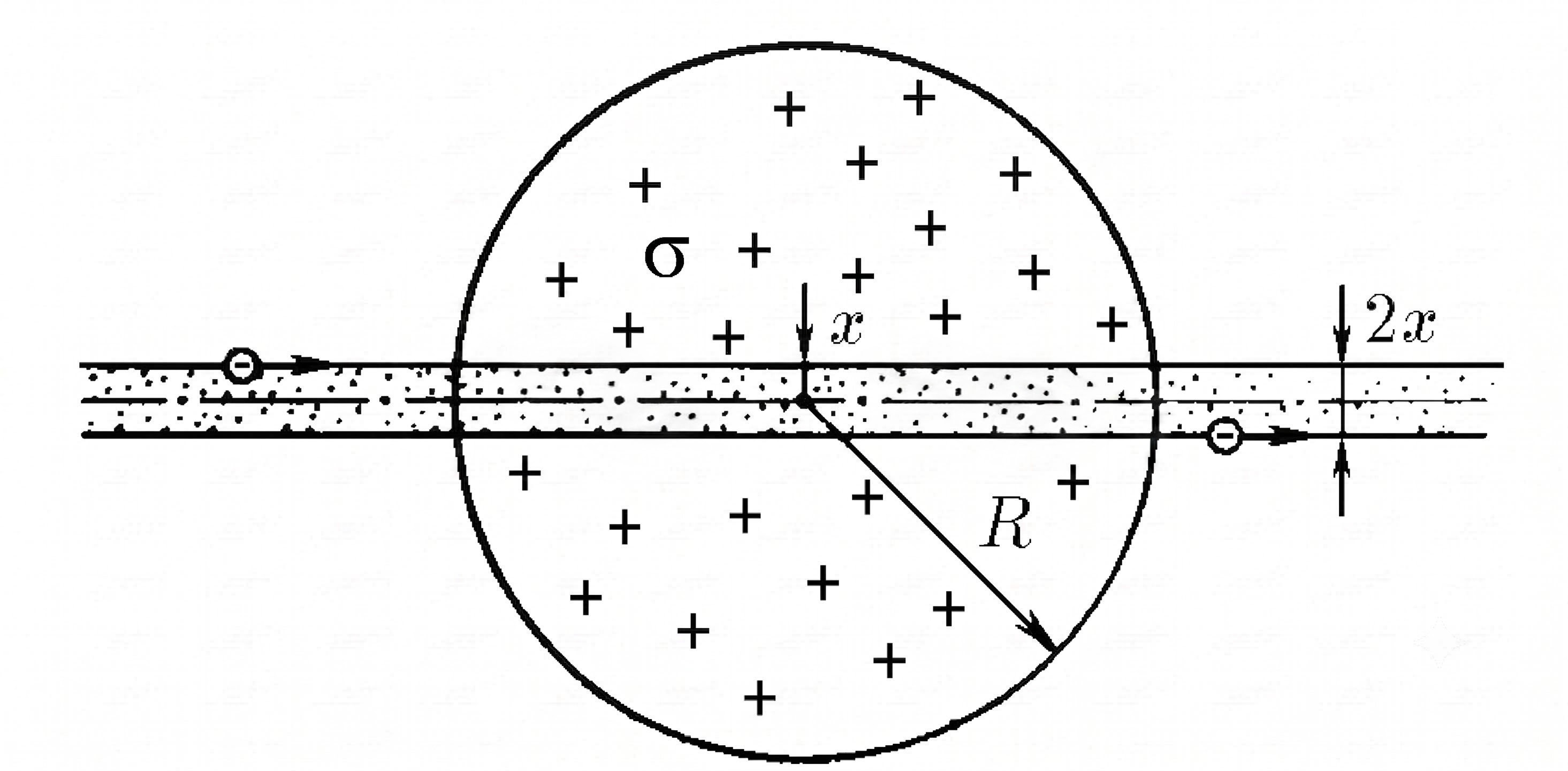
| $7.2.9.$ A thin parallel beam of charged particles accelerated by a potential difference $V_0$ passes through the center of a uniformly charged spherical cavity. At what distance will this beam focus if the potential at the center of the sphere is $V \ll V_0$? | | $7.2.9.$ A thin parallel beam of charged particles accelerated by a potential difference $V_0$ passes through the center of a uniformly charged spherical cavity. At what distance will this beam focus if the potential at the center of the sphere is $V \ll V_0$? |
| | | |
| ### Solution | | ### Solution |
| | | |
| In this solution, the problem is considered in strict accordance with the text of the condition: the model is a uniformly charged empty spherical shell, all of whose charge is concentrated on the surface, with two small holes for the beam to pass through. | | In this solution, the problem is considered in strict accordance with the text of the condition: the model is a uniformly charged empty spherical shell, all of whose charge is concentrated on the surface, with two small holes for the beam to pass through. |
|  | |  |
| | | |
| #### 1. Physical model and superposition principle | | #### 1. Physical model and superposition principle |
| | | |
| Since $V \ll V_0$, the change in the longitudinal kinetic energy of the beam is negligible ($qV \ll qV_0$). The particle velocity $v$ along the axis can be considered constant. Furthermore, given the enormous speed of the beam and the traditional assumptions of such problems, we neglect the influence of the external scattering field at large distances from the sphere, focusing only on the sharp local field "kicks" directly at the holes (the aperture lens effect). | | Since $V \ll V_0$, the change in the longitudinal kinetic energy of the beam is negligible ($qV \ll qV_0$). The particle velocity $v$ along the axis can be considered constant. Furthermore, given the enormous speed of the beam and the traditional assumptions of such problems, we neglect the influence of the external scattering field at large distances from the sphere, focusing only on the sharp local field "kicks" directly at the holes (the aperture lens effect). |
| | | |
| To strictly calculate the local fields, we apply the superposition principle. Let us represent the real shell with two holes as a superposition of two ideal systems: | | To strictly calculate the local fields, we apply the superposition principle. Let us represent the real shell with two holes as a superposition of two ideal systems: |
| 1. An ideal continuous charged sphere with a surface charge density $+\sigma$. | | 1. An ideal continuous charged sphere with a surface charge density $+\sigma$. |
| 2. Two "virtual" disks with a charge density $-\sigma$, located strictly at the positions of the entrance and exit holes. | | 2. Two "virtual" disks with a charge density $-\sigma$, located strictly at the positions of the entrance and exit holes. |
| | | |
| Inside an ideal continuous sphere, the electric field is strictly zero. Therefore, all the focusing transverse field inside the cavity near the holes is created exclusively by these two virtual disks with a charge of $-\sigma$. | | Inside an ideal continuous sphere, the electric field is strictly zero. Therefore, all the focusing transverse field inside the cavity near the holes is created exclusively by these two virtual disks with a charge of $-\sigma$. |
| | | |
| #### 2. First transverse momentum at the entrance | | #### 2. First transverse momentum at the entrance |
| | | |
| Let a particle fly at a distance $x$ from the beam's axis of symmetry ($x \ll R$). Let's find the transverse momentum acquired from the local field of the first hole. | | Let a particle fly at a distance $x$ from the beam's axis of symmetry ($x \ll R$). Let's find the transverse momentum acquired from the local field of the first hole. |
| | | |
| Let's isolate a small Gaussian cylinder of radius $x$ and thickness $dz$, encompassing only the region of the entrance hole itself. Within our mathematical superposition model, this cylinder contains the charge of the virtual disk, equal in magnitude to $|\Delta q| = \pi x^2 \sigma$. The negative sign of this effective charge means the field is directed towards the axis (creating a focusing effect). | | Let's isolate a small Gaussian cylinder of radius $x$ and thickness $dz$, encompassing only the region of the entrance hole itself. Within our mathematical superposition model, this cylinder contains the charge of the virtual disk, equal in magnitude to $|\Delta q| = \pi x^2 \sigma$. The negative sign of this effective charge means the field is directed towards the axis (creating a focusing effect). |
| | | |
| By Gauss's theorem, the flux of the electric field vector through the lateral surface of this cylinder is: | | By Gauss's theorem, the flux of the electric field vector through the lateral surface of this cylinder is: |
| $$ 2\pi x \int E_\perp dz = \frac{\pi x^2 \sigma}{\varepsilon_0} $$ | | $$ 2\pi x \int E_\perp dz = \frac{\pi x^2 \sigma}{\varepsilon_0} $$ |
| | | |
| From this, the integral of the transverse field in the local hole zone is: | | From this, the integral of the transverse field in the local hole zone is: |
| $$ \int E_\perp dz = \frac{\sigma x}{2\varepsilon_0} $$ | | $$ \int E_\perp dz = \frac{\sigma x}{2\varepsilon_0} $$ |
| | | |
| The transverse momentum the particle acquires by breaking through this local field is: | | The transverse momentum the particle acquires by breaking through this local field is: |
| $$ p_{\perp 1} = \int q E_\perp \frac{dz}{v} = \frac{q}{v} \int E_\perp dz = \frac{q \sigma x}{2\varepsilon_0 v} $$ | | $$ p_{\perp 1} = \int q E_\perp \frac{dz}{v} = \frac{q}{v} \int E_\perp dz = \frac{q \sigma x}{2\varepsilon_0 v} $$ |
| | | |
| #### 3. Focus check inside the cavity | | #### 3. Focus check inside the cavity |
| | | |
| Having received the first transverse momentum, the particle flies deeper into the cavity, acquiring a transverse velocity $v_\perp = \frac{p_{\perp 1}}{m}$ directed towards the beam axis. | | Having received the first transverse momentum, the particle flies deeper into the cavity, acquiring a transverse velocity $v_\perp = \frac{p_{\perp 1}}{m}$ directed towards the beam axis. |
| | | |
| The time to reach the axis is $t = \frac{x}{v_\perp}$. The focal length after the first hole $f_1$: | | The time to reach the axis is $t = \frac{x}{v_\perp}$. The focal length after the first hole $f_1$: |
| $$f_1 = vt = v \frac{x}{v_\perp} = x \frac{mv}{p_{\perp 1}} = x \frac{mv}{\frac{q \sigma x}{2\varepsilon_0 v}} = \frac{2mv^2 \varepsilon_0}{q \sigma}$$ | | $$f_1 = vt = v \frac{x}{v_\perp} = x \frac{mv}{p_{\perp 1}} = x \frac{mv}{\frac{q \sigma x}{2\varepsilon_0 v}} = \frac{2mv^2 \varepsilon_0}{q \sigma}$$ |
| | | |
| The kinetic energy is given by the accelerating voltage: $mv^2 = 2qV_0$. | | The kinetic energy is given by the accelerating voltage: $mv^2 = 2qV_0$. |
| The potential of the sphere is $V = \frac{\sigma R}{\varepsilon_0}$, which implies $\sigma = \frac{\varepsilon_0 V}{R}$. | | The potential of the sphere is $V = \frac{\sigma R}{\varepsilon_0}$, which implies $\sigma = \frac{\varepsilon_0 V}{R}$. |
| Substituting into $f_1$: | | Substituting into $f_1$: |
| $$f_1 = \frac{2(2qV_0) \varepsilon_0}{q \left(\frac{\varepsilon_0 V}{R}\right)} = 4R \frac{V_0}{V}$$ | | $$f_1 = \frac{2(2qV_0) \varepsilon_0}{q \left(\frac{\varepsilon_0 V}{R}\right)} = 4R \frac{V_0}{V}$$ |
| | | |
| Since $V \ll V_0$, then $f_1 \gg R$. The beam travels too fast and does not have time to focus inside the cavity, reaching the exit hole at practically the same distance $x$ from the axis. | | Since $V \ll V_0$, then $f_1 \gg R$. The beam travels too fast and does not have time to focus inside the cavity, reaching the exit hole at practically the same distance $x$ from the axis. |
| | | |
| #### 4. Second momentum and total focal length | | #### 4. Second momentum and total focal length |
| | | |
| Flying through the exit hole, the particle crosses the local field of the second virtual disk ($-\sigma$) and receives a similar transverse momentum directed towards the axis: | | Flying through the exit hole, the particle crosses the local field of the second virtual disk ($-\sigma$) and receives a similar transverse momentum directed towards the axis: |
| $$ p_{\perp 2} = \frac{q \sigma x}{2\varepsilon_0 v} $$ | | $$ p_{\perp 2} = \frac{q \sigma x}{2\varepsilon_0 v} $$ |
| | | |
| The total transverse momentum after exiting: | | The total transverse momentum after exiting: |
| $$ p_\perp = p_{\perp 1} + p_{\perp 2} = \frac{q \sigma x}{\varepsilon_0 v} $$ | | $$ p_\perp = p_{\perp 1} + p_{\perp 2} = \frac{q \sigma x}{\varepsilon_0 v} $$ |
| | | |
| The final focal length $f$ of the entire system: | | The final focal length $f$ of the entire system: |
| $$ f = x \frac{mv}{p_\perp} = x \frac{mv}{\frac{q \sigma x}{\varepsilon_0 v}} = \frac{mv^2 \varepsilon_0}{q \sigma} $$ | | $$ f = x \frac{mv}{p_\perp} = x \frac{mv}{\frac{q \sigma x}{\varepsilon_0 v}} = \frac{mv^2 \varepsilon_0}{q \sigma} $$ |
| | | |
| Substituting $mv^2 = 2qV_0$ and $\sigma = \frac{\varepsilon_0 V}{R}$, we obtain the final answer for an empty spherical shell: | | Substituting $mv^2 = 2qV_0$ and $\sigma = \frac{\varepsilon_0 V}{R}$, we obtain the final answer for an empty spherical shell: |
| $$ f = \frac{(2qV_0) \varepsilon_0}{q \left(\frac{\varepsilon_0 V}{R}\right)} = 2R \frac{V_0}{V} $$ | | $$ f = \frac{(2qV_0) \varepsilon_0}{q \left(\frac{\varepsilon_0 V}{R}\right)} = 2R \frac{V_0}{V} $$ |
| | | |
