Statement
Solution
In this solution, the problem is considered in strict accordance with the text of the condition: the model is a uniformly charged empty spherical shell, all of whose charge is concentrated on the surface, with two small holes for the beam to pass through.
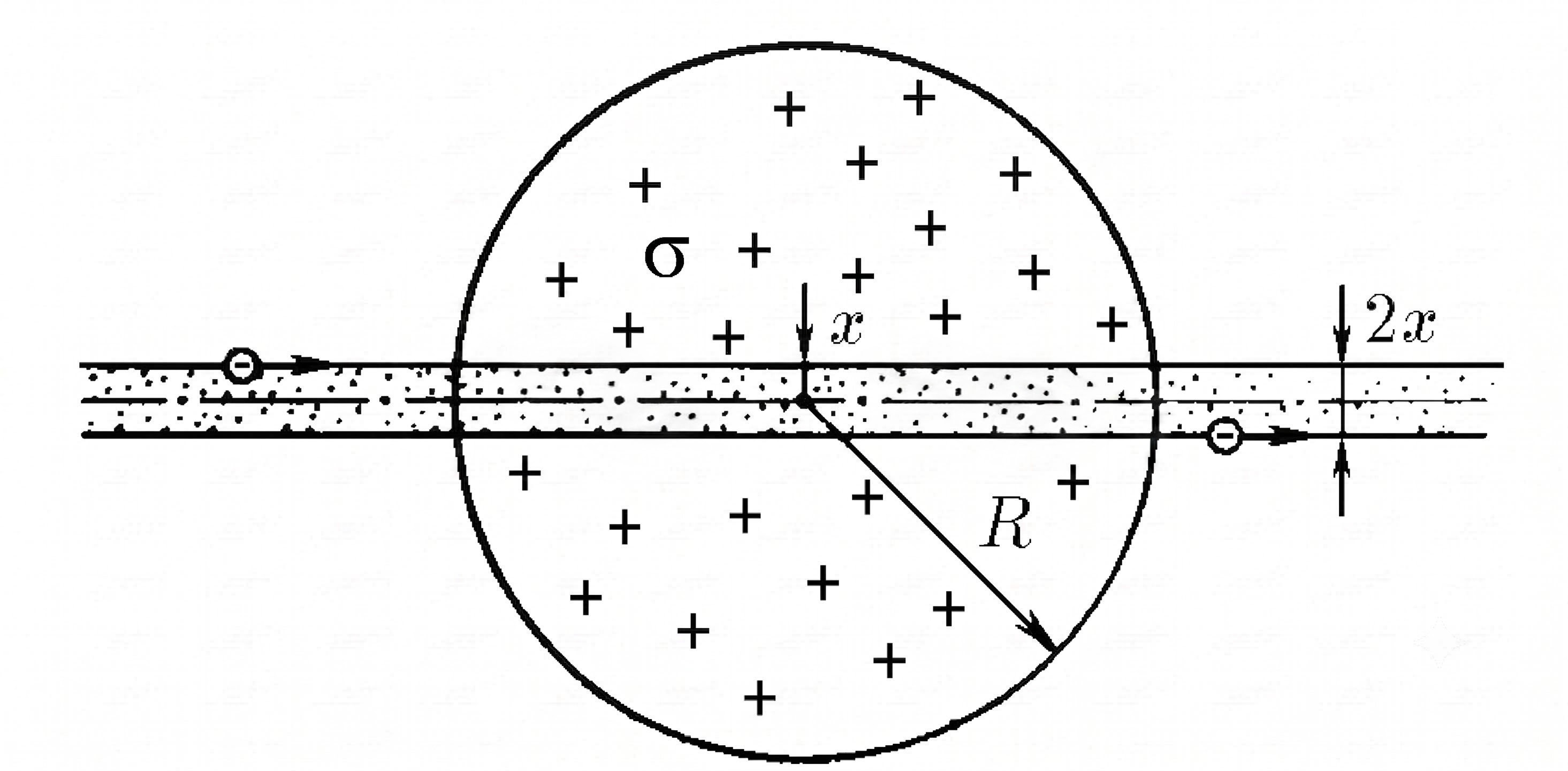
1. Physical model and superposition principle
Since
To strictly calculate the local fields, we apply the superposition principle. Let us represent the real shell with two holes as a superposition of two ideal systems:
- An ideal continuous charged sphere with a surface charge density
. - Two "virtual" disks with a charge density
, located strictly at the positions of the entrance and exit holes.
Inside an ideal continuous sphere, the electric field is strictly zero. Therefore, all the focusing transverse field inside the cavity near the holes is created exclusively by these two virtual disks with a charge of
2. First transverse momentum at the entrance
Let a particle fly at a distance
Let's isolate a small Gaussian cylinder of radius
By Gauss's theorem, the flux of the electric field vector through the lateral surface of this cylinder is:
From this, the integral of the transverse field in the local hole zone is:
The transverse momentum the particle acquires by breaking through this local field is:
3. Focus check inside the cavity
Having received the first transverse momentum, the particle flies deeper into the cavity, acquiring a transverse velocity
The time to reach the axis is
The kinetic energy is given by the accelerating voltage:
The potential of the sphere is
Substituting into
Since
4. Second momentum and total focal length
Flying through the exit hole, the particle crosses the local field of the second virtual disk (
The total transverse momentum after exiting:
The final focal length
Substituting
Answer
*Note: This result is a strict consequence for an empty spherical shell. The answer in the official solutions manual is likely obtained for an alternative model, possibly - a solid charged sphere with a through cylindrical channel.*
Discussion
Log in to join the discussion