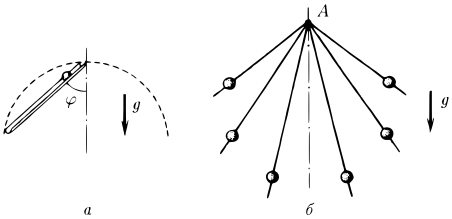
$1.3.2.$ a. From the top point of the circle, a ball begins to slide along a smooth chute at an angle $\varphi$ to the vertical. How long will it take for it to reach the circle, if its diameter is $D$?
b. From point $A$, small beads begin to slide along the spokes with different slopes at the same time without friction. What curve will the beads be on at time $t$?
### Solution
a) A ball will move along a smooth chute with acceleration equal to the projection of the free-fall acceleration in the direction of motion, i.e.
$$
a = g \cdot\cos{\varphi}
$$
The displacement of the ball is the chord of a circle of diameter $D$, the magnitude of which is related to the diameter, by the following relation
$$
r = D \cdot\cos{\varphi}
$$
Let's write further the equation of accelerated motion of the ball and from it find the time of motion
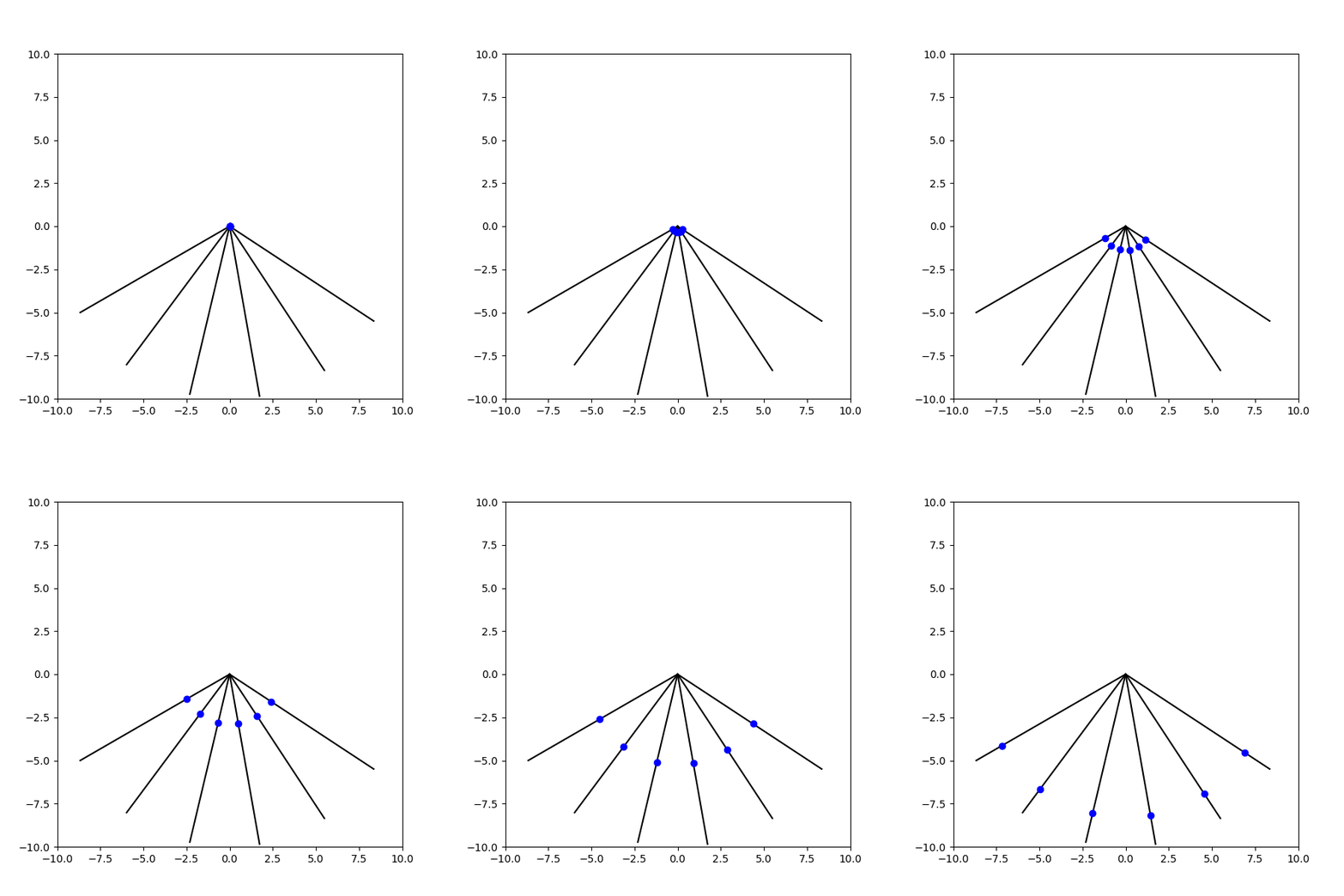
b) Note that the expression $(1)$ does not include the value of the angle, so all balls will be dropped simultaneously. They will lie on a circle of radius$r = g t^2/2$, as shown in the animation
+
b) Note that the expression $(1)$ does not include the value of the angle, so all balls will be dropped simultaneously. They will lie on a circle of diameter $r = g t^2/2$, as shown in the animation
#### Answer
a. $t = \sqrt{2D/g}$
−
b. On a circle of radius$\frac{gt^{2}}{2}$ with top point $A$.
+
b. On a circle of diameter $\frac{gt^{2}}{2}$ with top point $A$.
ещё строк без изменений 3
### Statement
### Statement
$1.3.2.$ a. From the top point of the circle, a ball begins to slide along a smooth chute at an angle $\varphi$ to the vertical. How long will it take for it to reach the circle, if its diameter is $D$?
$1.3.2.$ a. From the top point of the circle, a ball begins to slide along a smooth chute at an angle $\varphi$ to the vertical. How long will it take for it to reach the circle, if its diameter is $D$?
b. From point $A$, small beads begin to slide along the spokes with different slopes at the same time without friction. What curve will the beads be on at time $t$?
b. From point $A$, small beads begin to slide along the spokes with different slopes at the same time without friction. What curve will the beads be on at time $t$?


### Solution
### Solution


a) A ball will move along a smooth chute with acceleration equal to the projection of the free-fall acceleration in the direction of motion, i.e.
a) A ball will move along a smooth chute with acceleration equal to the projection of the free-fall acceleration in the direction of motion, i.e.
$$
$$
a = g \cdot\cos{\varphi}
a = g \cdot\cos{\varphi}
$$
$$
The displacement of the ball is the chord of a circle of diameter $D$, the magnitude of which is related to the diameter, by the following relation
The displacement of the ball is the chord of a circle of diameter $D$, the magnitude of which is related to the diameter, by the following relation
$$
$$
r = D \cdot\cos{\varphi}
r = D \cdot\cos{\varphi}
$$
$$
Let's write further the equation of accelerated motion of the ball and from it find the time of motion
Let's write further the equation of accelerated motion of the ball and from it find the time of motion
b) Note that the expression $(1)$ does not include the value of the angle, so all balls will be dropped simultaneously. They will lie on a circle of radius$r = g t^2/2$, as shown in the animation
b) Note that the expression $(1)$ does not include the value of the angle, so all balls will be dropped simultaneously. They will lie on a circle of diameter $r = g t^2/2$, as shown in the animation
#### Answer
#### Answer
a. $t = \sqrt{2D/g}$
a. $t = \sqrt{2D/g}$
b. On a circle of radius$\frac{gt^{2}}{2}$ with top point $A$.
b. On a circle of diameter $\frac{gt^{2}}{2}$ with top point $A$.
