A stream of air moves over the surface of the water. How will this affect the direction of propagation of reflected and refracted sound waves?
Solution
For problem
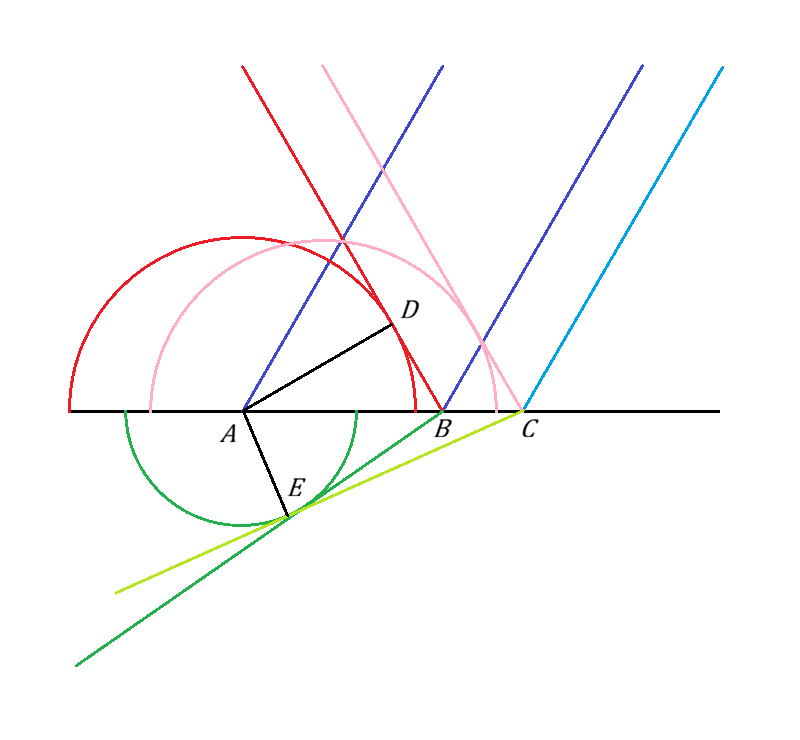
The dark blue lines in the figure are the same wavefront s apart when wind is absent and the figure shows the moment when the wavefront has just reached . The red spherical wave emitted from (and those from other points) determines the red wavefront and the reflected angle. When wind with velocity m/s to the right is present, the incident wavefront (light blue) and the spherical wave emitted from and reflected wavefront (pink) are shifted by the same distance . As a result, the reflected angle remains the same.
While the green spherical wave emitted from in the water is unaffected by wind, the refracted angle changes as follows. (In the figure, dark and light green refracted wavefronts are those when wind is absent and present, respectively.) Let denote the incident (and reflected) angle and denote the refracted angle. Since the radii of the red and green spherical waves are and (which correspond to speeds of sound in air and water, respectively), we have
Eliminating from these two equations, we obtain a modified law of refraction
Discussion
Log in to join the discussion