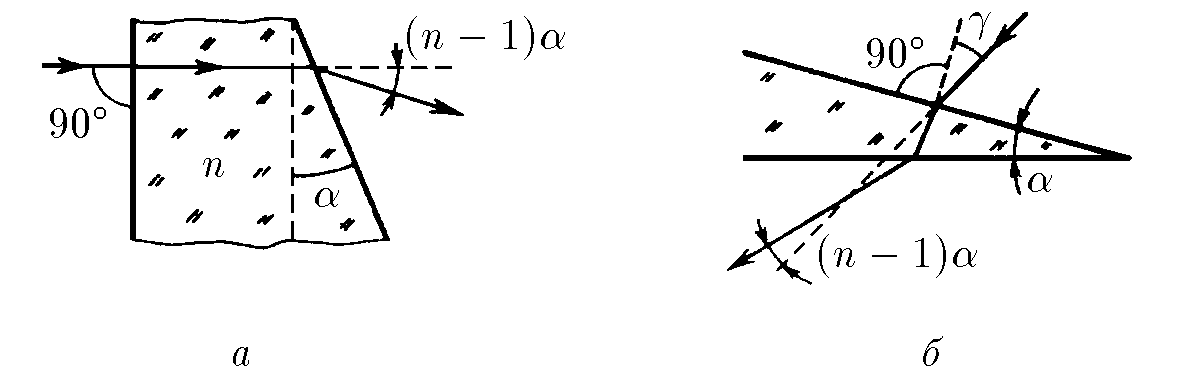
$13.2.14.$ a. A light beam passes through a wedge with a small angle $\alpha$ at the vertex,
@@ -4,12 +4,10 @@Statement
which is perpendicular to the front face of the wedge. Prove that the angle
of deflection of the ray from the initial direction is approximately $(n − 1) \alpha$.
Refractive index of the wedge $n$.
−
b. A light ray passes through a wedge with a small angle $\alpha$ at the vertex,
which falls at a small angle $\gamma$ to the normal to the front surface of the wedge.
Prove that the angle of deflection of the light beam from the initial direction
is approximately $(n − 1) \alpha$. Refractive index of the wedge $n$.
−
c. Print the formula for the focal length of a thin lens. The radii of curvature
of the lens surface are $R_1$ and $R_2$, and the refractive index of the lens material
is $n$.
### Solution
#### 1. Hitting the first surface
Let's imagine there is a parallel lays of light entering the lens with refractive index $n_1$ from media with refractive index $n_0$, and after lens there is a media with refractive index $n_2$.
First, let's consider the moment when ray hits front of lens at the point $h$ above optical axis.
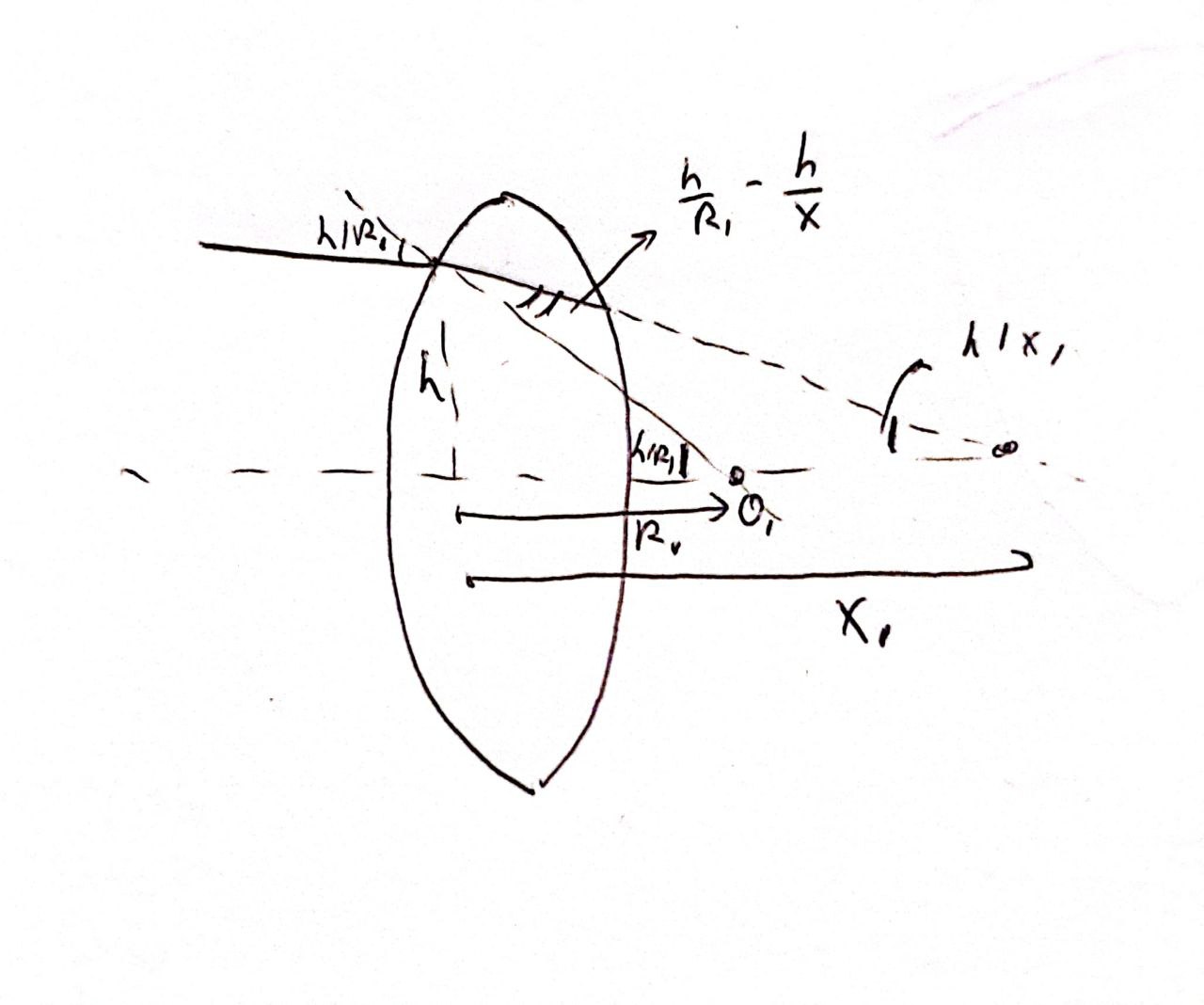
As shown in the picture, the incidence angle is $$\tan(\alpha) \approx\frac{h}{R_1}\approx sin{(\alpha)}\approx\alpha$$
where $R_1$ is the curvature radius of first surface.
If there wasn't second surface, the ray after refraction will cross the optical axis at point $x_1$, and angle is $\tan(b) \approx\sin(\beta) \approx\beta = x_1/h$. So, the refraction angle is
<i>The solution was kindly provided by David Hayrapetyan</i>
unchanged lines 67
### Statement
### Statement
$13.2.14.$ a. A light beam passes through a wedge with a small angle $\alpha$ at the vertex,
$13.2.14.$ a. A light beam passes through a wedge with a small angle $\alpha$ at the vertex,
@@ -4,12 +4,10 @@Statement
which is perpendicular to the front face of the wedge. Prove that the angle
which is perpendicular to the front face of the wedge. Prove that the angle
of deflection of the ray from the initial direction is approximately $(n − 1) \alpha$.
of deflection of the ray from the initial direction is approximately $(n − 1) \alpha$.
Refractive index of the wedge $n$.
Refractive index of the wedge $n$.
b. A light ray passes through a wedge with a small angle $\alpha$ at the vertex,
b. A light ray passes through a wedge with a small angle $\alpha$ at the vertex,
which falls at a small angle $\gamma$ to the normal to the front surface of the wedge.
which falls at a small angle $\gamma$ to the normal to the front surface of the wedge.
Prove that the angle of deflection of the light beam from the initial direction
Prove that the angle of deflection of the light beam from the initial direction
is approximately $(n − 1) \alpha$. Refractive index of the wedge $n$.
is approximately $(n − 1) \alpha$. Refractive index of the wedge $n$.
c. Print the formula for the focal length of a thin lens. The radii of curvature
c. Print the formula for the focal length of a thin lens. The radii of curvature
of the lens surface are $R_1$ and $R_2$, and the refractive index of the lens material
of the lens surface are $R_1$ and $R_2$, and the refractive index of the lens material
is $n$.
is $n$.


### Solution
### Solution
#### 1. Hitting the first surface
#### 1. Hitting the first surface
Let's imagine there is a parallel lays of light entering the lens with refractive index $n_1$ from media with refractive index $n_0$, and after lens there is a media with refractive index $n_2$.
Let's imagine there is a parallel lays of light entering the lens with refractive index $n_1$ from media with refractive index $n_0$, and after lens there is a media with refractive index $n_2$.
First, let's consider the moment when ray hits front of lens at the point $h$ above optical axis.
First, let's consider the moment when ray hits front of lens at the point $h$ above optical axis.


As shown in the picture, the incidence angle is $$\tan(\alpha) \approx\frac{h}{R_1}\approx sin{(\alpha)}\approx\alpha$$
As shown in the picture, the incidence angle is $$\tan(\alpha) \approx\frac{h}{R_1}\approx sin{(\alpha)}\approx\alpha$$
where $R_1$ is the curvature radius of first surface.
where $R_1$ is the curvature radius of first surface.
If there wasn't second surface, the ray after refraction will cross the optical axis at point $x_1$, and angle is $\tan(b) \approx\sin(\beta) \approx\beta = x_1/h$. So, the refraction angle is
If there wasn't second surface, the ray after refraction will cross the optical axis at point $x_1$, and angle is $\tan(b) \approx\sin(\beta) \approx\beta = x_1/h$. So, the refraction angle is
