Edit to “Solution”

en/7.1.23.md
+1 −1
| ### Statement | |||
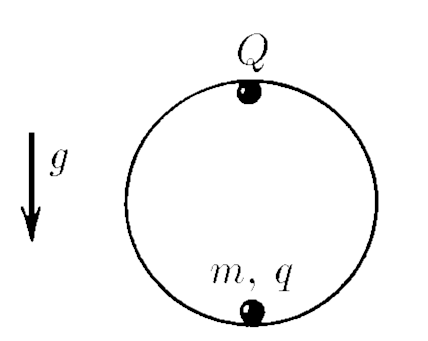
| $7.1.23^*.$ Find the period of small vibrations of a body of mass $m$, whose charge is $q$, inside a smooth sphere of radius $R$, if the charge $Q$ is fixed at the top point of the sphere. | |||
|  | |||
| ### Solution | |||
| @@ -8,8 +8,8 @@Solution | |||
| 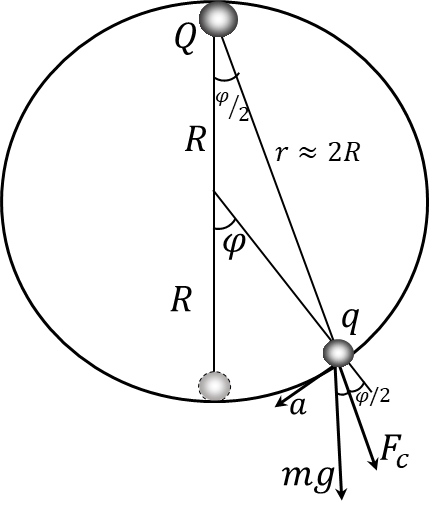 Forces acting on the system of two charges | |||
| − | Considering the fact that oscillations are small, $\varphi \ll 1$, we could use the approximations for small angle $\varphi$ $$\sin\varphi \approx \varphi; \quad\cos\varphi \approx 1 | ||
| + | Considering the fact that oscillations are small, $\varphi \ll 1$, we could use the approximations for small angle $\varphi$ $$\sin\varphi \approx \varphi; \quad\cos\varphi \approx 1\tag{1}$$ From where, we could approximate that the distance between charges remains approximately the same $$r\approx2R$$ Thus, the сoulomb's law for two charges $$F_c = \frac{1}{4\pi\varepsilon_0}\frac{qQ}{4R^2}$$ Let's write Newton's second law on a tangential trajectory, in the direction of motion of a charge of mass $m$ $$ma = mg \sin\varphi + F_c \sin\frac{\varphi}{2}$$ Considering the approximation $(1)$ and the expression $$ma = -mg\frac{x}{R} - \frac{x}{2R} \frac{1}{4\pi\varepsilon_0}\frac{qQ}{4R^2}$$ $$a = -x\left(\frac{g}{R}+\frac{qQ}{32\pi\varepsilon_0mR^3}\right)$$ Solving the equation of harmonic oscillations $(\ddot{x}+\omega^2x(t)=0)$, we could obtain the value for angular velocity $$\omega =\sqrt{\frac{g}{R}+\frac{qQ}{32\pi\varepsilon_0mR^3}}$$ From here the period of oscillation $$\boxed{T=\frac{2\pi}{\omega} = \frac{2\pi}{\sqrt{\frac{g}{R}+\frac{qQ}{32\pi\varepsilon_0mR^3}}}}$$ Since the expression under the square root cannot be less than zero, the ratio at which there will be no oscillations $$\frac{g}{R}+\frac{qQ}{32\pi\varepsilon_0mR^3} > 0 \Leftrightarrow \boxed{\frac{qQ}{32\pi\varepsilon_0R^2}>-mg}$$ | ||
| #### Answer | |||
| $$T=2\pi\left(\frac{g}{R}+\frac{qQ}{32\pi\varepsilon_0mR^3}\right)^{-1/2}\text{ with }\frac{qQ}{32\pi\varepsilon_0R^2}>-mg$$ | |||
| ### Statement | ### Statement | ||
| $7.1.23^*.$ Find the period of small vibrations of a body of mass $m$, whose charge is $q$, inside a smooth sphere of radius $R$, if the charge $Q$ is fixed at the top point of the sphere. | $7.1.23^*.$ Find the period of small vibrations of a body of mass $m$, whose charge is $q$, inside a smooth sphere of radius $R$, if the charge $Q$ is fixed at the top point of the sphere. | ||
|  |  | ||
| ### Solution | ### Solution | ||
| @@ -8,8 +8,8 @@Solution | |||
|  Forces acting on the system of two charges |  Forces acting on the system of two charges | ||
| Considering the fact that oscillations are small, $\varphi \ll 1$, we could use the approximations for small angle $\varphi$ $$\sin\varphi \approx \varphi; \quad\cos\varphi \approx 1 |
Considering the fact that oscillations are small, $\varphi \ll 1$, we could use the approximations for small angle $\varphi$ $$\sin\varphi \approx \varphi; \quad\cos\varphi \approx 1\tag{1}$$ From where, we could approximate that the distance between charges remains approximately the same $$r\approx2R$$ Thus, the сoulomb's law for two charges $$F_c = \frac{1}{4\pi\varepsilon_0}\frac{qQ}{4R^2}$$ Let's write Newton's second law on a tangential trajectory, in the direction of motion of a charge of mass $m$ $$ma = mg \sin\varphi + F_c \sin\frac{\varphi}{2}$$ Considering the approximation $(1)$ and the expression $$ma = -mg\frac{x}{R} - \frac{x}{2R} \frac{1}{4\pi\varepsilon_0}\frac{qQ}{4R^2}$$ $$a = -x\left(\frac{g}{R}+\frac{qQ}{32\pi\varepsilon_0mR^3}\right)$$ Solving the equation of harmonic oscillations $(\ddot{x}+\omega^2x(t)=0)$, we could obtain the value for angular velocity $$\omega =\sqrt{\frac{g}{R}+\frac{qQ}{32\pi\varepsilon_0mR^3}}$$ From here the period of oscillation $$\boxed{T=\frac{2\pi}{\omega} = \frac{2\pi}{\sqrt{\frac{g}{R}+\frac{qQ}{32\pi\varepsilon_0mR^3}}}}$$ Since the expression under the square root cannot be less than zero, the ratio at which there will be no oscillations $$\frac{g}{R}+\frac{qQ}{32\pi\varepsilon_0mR^3} > 0 \Leftrightarrow \boxed{\frac{qQ}{32\pi\varepsilon_0R^2}>-mg}$$ | ||
| #### Answer | #### Answer | ||
| $$T=2\pi\left(\frac{g}{R}+\frac{qQ}{32\pi\varepsilon_0mR^3}\right)^{-1/2}\text{ with }\frac{qQ}{32\pi\varepsilon_0R^2}>-mg$$ | $$T=2\pi\left(\frac{g}{R}+\frac{qQ}{32\pi\varepsilon_0mR^3}\right)^{-1/2}\text{ with }\frac{qQ}{32\pi\varepsilon_0R^2}>-mg$$ | ||