Statement
$6.6.18.$ A conducting sphere of radius $r$ carrying charge $Q$ is surrounded by a dielectric layer whose outer radius is $R$. The dielectric permittivity of the layer is $\varepsilon$. Find the surface charge density on the inner and outer surfaces of the dielectric layer. Draw the electric field lines. Plot the field strength and potential as functions of the distance from the centre of the sphere.
Solution
We will use Gauss's theorem in the form
$$
\oint \vec D \, d\vec S = Q,
$$
where $D = \varepsilon_0 E$ in vacuum and $D = \varepsilon\varepsilon_0 E$ in the dielectric. In this formulation, only free charges are taken into account, i.e., the induced charges on the surfaces of the dielectric can be ignored.
Take a concentric spherical Gaussian surface of radius $\rho$. Obviously, for $\rho < r$ the field is zero – since inside a conductor it cannot exist.
For $r \leq \rho < R$:
$$
\varepsilon\varepsilon_0 E \cdot 4\pi\rho^2 = Q,
$$
$$
E_1 = \frac{Q}{4\pi\rho^2 \varepsilon\varepsilon_0}.
$$
For $\rho \geq R$:
$$
\varepsilon_0 E \cdot 4\pi\rho^2 = Q,
$$
$$
E_2 = \frac{Q}{4\pi\rho^2 \varepsilon_0}.
$$
Plotting this gives jumps at the boundaries of the dielectric.
By definition, the potential at a point at distance $\rho$ from the centre of the system is equal to the work done by the electric field in transporting a unit positive charge from that point to infinity:
$$ \varphi(\rho) = \int_{\rho}^{\infty} E(\rho) \, d\rho. $$
For $\rho \ge R$:
$$ \varphi(\rho) = \int_{\rho}^{\infty} \frac{Q}{4\pi \varepsilon_0 \rho^2} \, d\rho = \frac{Q}{4\pi \varepsilon_0} \left[ -\frac{1}{x} \right]_{\rho}^{\infty} = \frac{Q}{4\pi \varepsilon_0 \rho}. $$
At the dielectric boundary ($\rho = R$):
$$ \varphi_2(R) = \frac{Q}{4\pi \varepsilon_0 R}. $$
For $r \leq \rho < R$:
Using the additivity of the integral, we split the path into two parts (inside the dielectric and in vacuum):
$$ \varphi(\rho) = \int_{\rho}^{R} E_1(\rho) \, d\rho + \int_{R}^{\infty} E_2(\rho) \, d\rho = \int_{\rho}^{R} \frac{Q}{4\pi \varepsilon_0 \varepsilon x^2} \, dx + \varphi_2(R), $$
$$ \varphi(\rho) = \frac{Q}{4\pi \varepsilon_0 \varepsilon} \left[ -\frac{1}{x} \right]_{\rho}^{R} + \frac{Q}{4\pi \varepsilon_0 R} = \frac{Q}{4\pi \varepsilon_0 \varepsilon} \left( \frac{1}{\rho} - \frac{1}{R} \right) + \frac{Q}{4\pi \varepsilon_0 R}. $$
The author rewrote this as:
$$ \varphi(\rho) = \frac{Q}{4\pi \varepsilon_0} \left[ \frac{1}{R} + \frac{1}{\varepsilon} \left( \frac{1}{\rho} - \frac{1}{R} \right) \right]. $$
For $0 \le \rho \le r$:
Since there is no electrostatic field inside a conductor ($E_1 = 0$), the work done in moving a charge inside the sphere is zero. Hence, the potential is the same at all points of the conductor and equals the potential at its surface ($\rho = r$):
$$ \varphi(\rho) = \varphi(r) = \frac{Q}{4\pi \varepsilon_0} \left[ \frac{1}{R} + \frac{1}{\varepsilon} \left( \frac{1}{r} - \frac{1}{R} \right) \right]. $$
Thus, the final potential distribution is:
$$ \varphi(\rho) =
\begin{cases}
\dfrac{Q}{4\pi \varepsilon_0} \left[ \dfrac{1}{R} + \dfrac{1}{\varepsilon} \left( \dfrac{1}{r} - \dfrac{1}{R} \right) \right], & 0 \le \rho \le r \\
\dfrac{Q}{4\pi \varepsilon_0} \left[ \dfrac{1}{R} + \dfrac{1}{\varepsilon} \left( \dfrac{1}{\rho} - \dfrac{1}{R} \right) \right], & r < \rho \le R \\
\dfrac{Q}{4\pi \varepsilon_0 \rho}, & \rho > R
\end{cases}
$$
Plotting this, there are no jumps. The graphs will look like this:
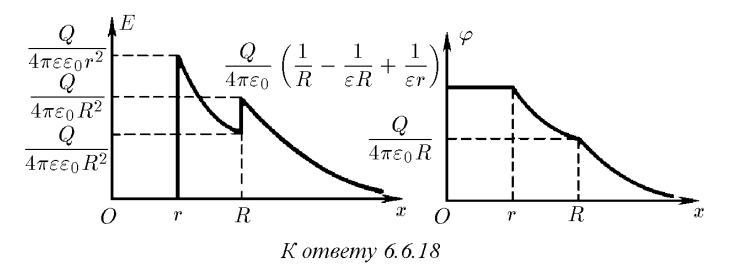
Now we find the charge densities at the boundaries.
At the inner boundary, the dielectric and the conductor are in contact. By the property of a conductor, all charge $Q$ of the sphere is concentrated on the inner boundary with the dielectric; let its density be
$$
\sigma = \frac{Q}{4\pi r^2}. \tag{1}
$$
In Irodov, there is a ready‑made formula for such a case:
$$
\boxed{\sigma' = -\frac{\varepsilon - 1}{\varepsilon} \sigma}. \tag{2}
$$
From this, we can immediately write the answer:
$$
\sigma_{in} = -\frac{(\varepsilon - 1)Q}{4\pi\varepsilon r^2}.
$$
Formula (2) is easy to derive. The field near the conductor, measured in the dielectric, is
$$
E = \frac{\sigma}{\varepsilon\varepsilon_0}. \tag{3}
$$
The density of the induced charge is determined by the jump in polarisation (the normal to the dielectric surface points toward the centre of the sphere, i.e., opposite to the field):
$$
\sigma' = \vec P \cdot \vec n = -P = -(\varepsilon - 1)\varepsilon_0 E. \tag{4}
$$
Substituting (3) into (4) gives the result. Note that the induced charge is opposite in sign to $Q$. Savchenko did not reflect this in his answer.
For the outer boundary (the normal points away from the centre), similarly,
$$
\sigma' = \vec P \cdot \vec n = P = (\varepsilon - 1)\varepsilon_0 E, \tag{5}
$$
$$
E = \frac{Q}{4\pi\varepsilon\varepsilon_0 R^2}.
$$
Note: we are still considering the field inside the dielectric, hence the $\varepsilon$.
$$
\sigma_{out} = \frac{(\varepsilon - 1)Q}{4\pi\varepsilon R^2}.
$$
This time the sign in the author's answer is correct.
Answer
$$
\sigma_{in} = -\frac{(\varepsilon - 1)Q}{4\pi\varepsilon r^2},
$$
$$
\sigma_{out} = \frac{(\varepsilon - 1)Q}{4\pi\varepsilon R^2}.
$$
Discussion
Log in to join the discussion