Statement
14.1.6∗.
Solve the problem 14.1.5 in the case when the relative speed of the second
station from observations from the first station is v. What is the relative speed
of the first station from observations from the second station?
Solution
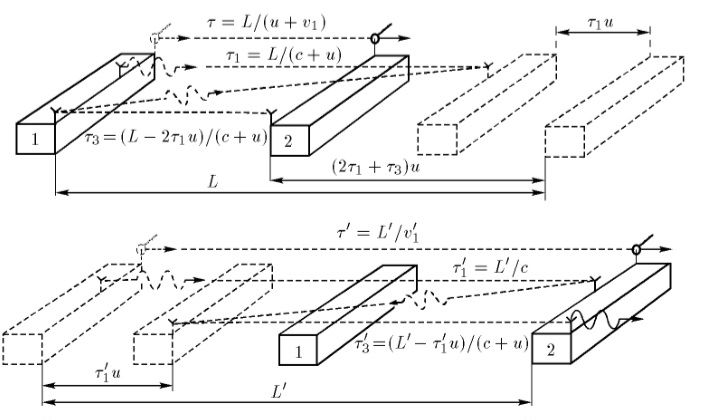
We have:
· System S: attached to the first station (E1), at rest.
· System S': attached to the second station (E2), which moves with velocity v along the x-axis relative to S.
We consider
· At
· From E1, the following are emitted simultaneously:
· A light pulse (speed c).
· A test probe (constant speed u along x, to be determined).
· The light travels: E1 → E2 (bounce) → E1 (bounce) → E2.
The probe arrives at E2 exactly at the same instant that the light pulse returns to E2 for the third time.
The position of E2 as a function of time:
· First leg (E1 → E2):
The light catches up to E2 when
· Second leg (E2 → E1):
At
· Third leg (E1 → E2):
The light leaves E1 again at
Solving:
Substituting
This is the total time the light takes to complete its path.
The probe moves with speed u and must catch E2 at the same instant
Equating with the expression for
Therefore, the speed of the probe as measured from the first station is:
For an observer at E2 (system S'), the probe moves with speed u' given by the relativistic velocity addition formula.
Since S' moves at speed v relative to S:
Substituting u and simplifying:
This is the speed at which the probe approaches the second station according to E2's instruments.
By reciprocity between inertial systems, if E2 moves with speed v relative to E1, then E1 moves with speed -v relative to E2. Hence:
The probe constitutes another inertial system (S''). For the probe:
· The first station moves with speed -u (magnitude u).
· The second station approaches with speed u' calculated above.
Thus, the probe's team records:
Discussion
Log in to join the discussion