Statement
$7.4.31.$ A point charge $q$ is placed on the axis of a cylindrical hole in a metal plate at some distance from the plate. The charge is released. Describe its motion qualitatively.
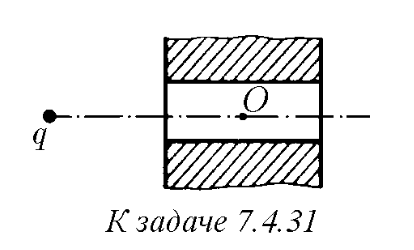
The charge induces opposite charges on the metal surface, therefore it is attracted to the plate (to the plane of the hole).
The charge begins to move with acceleration along the axis toward the hole. As it approaches the hole, the attractive force increases approximately according to the law (for $z \gg R$):
$$
F \propto \frac{1}{z^2}
$$There is no metal directly in front of the charge, so the main part of the induced charges is concentrated at the edges of the hole. Therefore, when the charge approaches the hole ($R \gg z$), the projection of the forces on the axis decreases, and the attractive force begins to decrease almost linearly:
$$
F \propto \frac{z}{(z^2+R^2)^{3/2}} \approx \frac{z}{R^3} \propto z
$$
Thus, in this approximation, the oscillations can be considered almost harmonic.At the moment when the charge is exactly in the centre of the hole (in the plane of the metal plate), all attractive forces from the symmetrically located edges of the hole balance each other, but by this moment the charge has already acquired its maximum speed (all potential energy has been converted into kinetic energy). By inertia, it passes through the centre.
When the charge crosses the plane of the plate and appears on the other side, the pattern of induced charges on the metal rearranges (the force now pulls it back toward the plate). The force vector changes direction to the opposite — now it decelerates the charge. The charge moves away from the plate, its speed decreases until it stops.
Then the cycle repeats.
Since the charge moves with acceleration, it continuously emits electromagnetic waves, losing energy. The induced charges in the plate are constantly moving — a current arises, which means Joule losses. Because of this, the oscillations will decay.
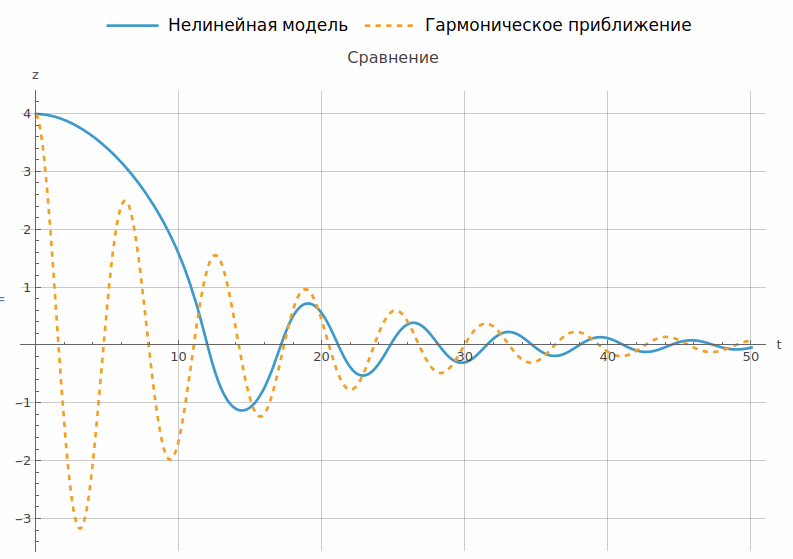
Thus, we obtain damped oscillations — but not harmonic if the amplitude is comparable to the radius of the hole. The differences can be quite significant:
Answer
Damped non‑harmonic oscillations about the point $O$.
Discussion
Log in to join the discussion