8.2.27∗. The current source consists of a thin plate of radioactive material surrounded by a conductive housing. The gap width between the housing and the plate is much smaller than the linear dimensions of the plate. How does the current depend on the voltage between the housing and the radioactive plate, if the current at a positive voltage is $I_0$? The energy of electrons escaping from the plates is $eV_0$. Electrons fly out in all directions evenly.
Solution
For problem $8.2.27$
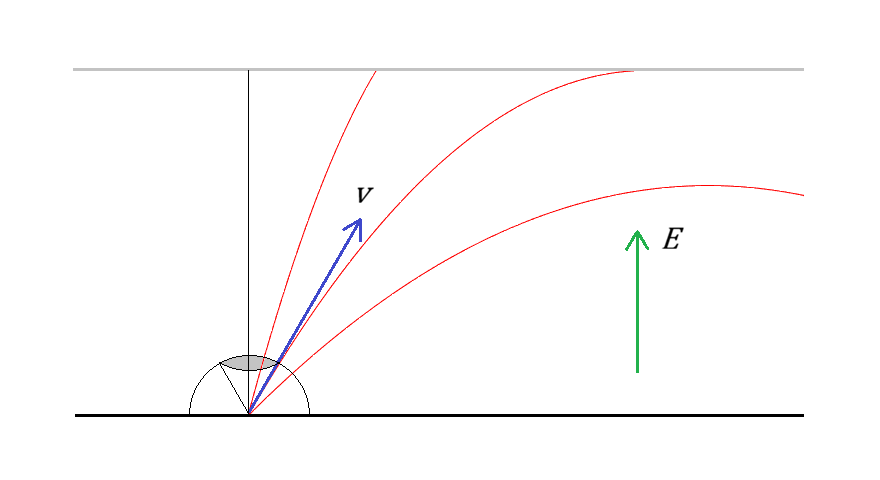
In order to create a stopping potential for electrons, the potential at the radioactive plate (shown as a thick black line) must be higher than that at the housing (shown as a thick gray line) so that the electric field points away from the plate. Let this potential difference be $V$. Since electrons leaving the plate have energy $eV_0$, their speed $v$ can be determined from
where $m$ is the mass of an electron. Suppose the velocity of an emitted electron makes an angle $\theta$ with a perpendicular line segment between the plate and the housing. Then, it can reach the housing if the kinetic energy due to the component of the velocity along this perpendicular line segment is at least $eV$, which is the potential energy that it will gain. Thus,
Since the ratio of the area of the spherical cap through which electrons emitted from a certain point can reach the housing to the the area of the hemisphere through which electrons from that point are emitted is $1-\cos\theta$. The ratio of conventional currents from the housing to the plate when the potential difference $V$ is present or absent is
Discussion
Log in to join the discussion